John Joseph Kane
Instructor in English; Rupert Radford 1915 Faculty Fellowship (1939-2023)
Fall 2025
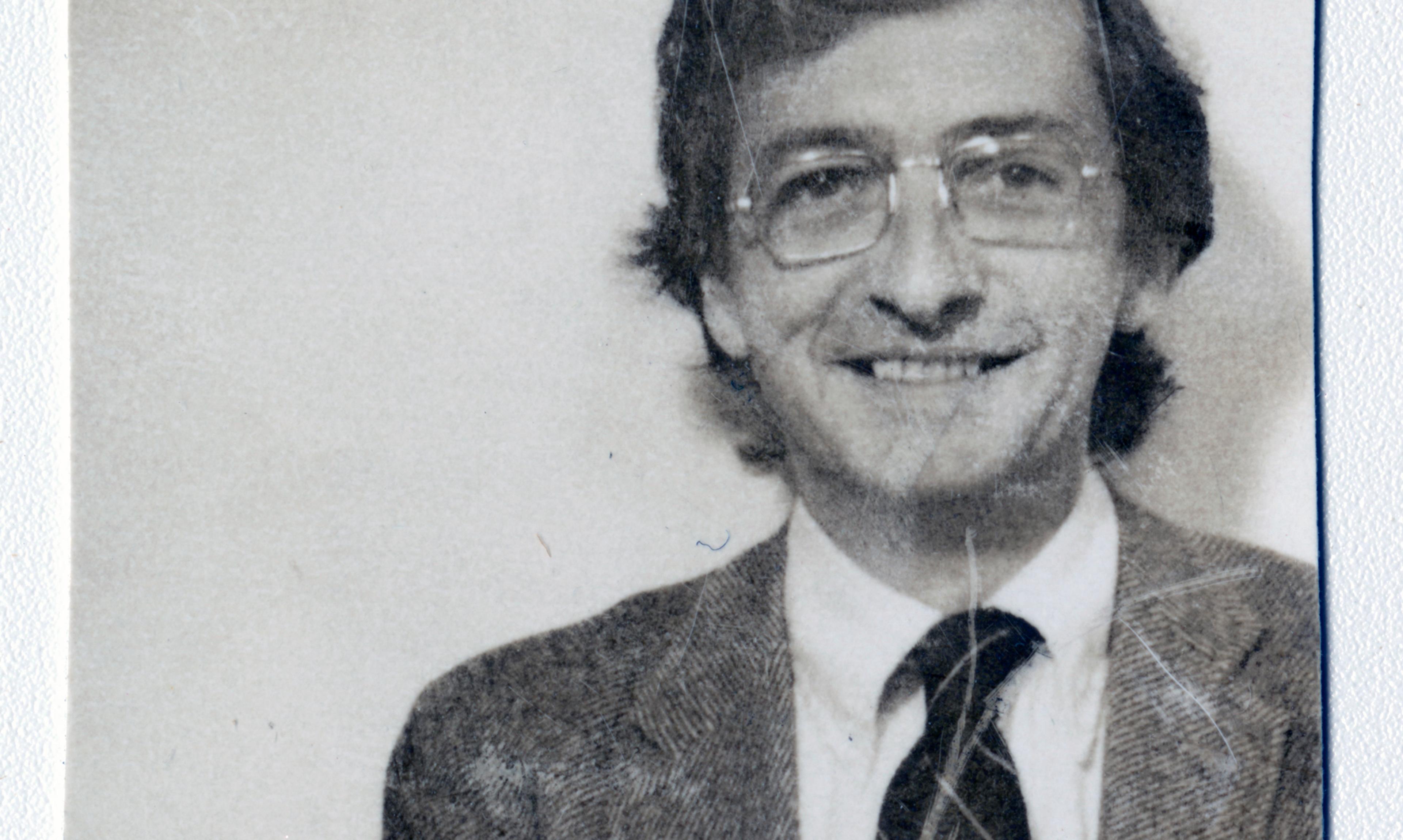
John Joseph Kane
Instructor in English; Rupert Radford 1915 Faculty Fellowship
(1939-2023)
John Joseph Kane was born in the Bronx on March 24, 1939. He graduated from the prestigious Regis High School on the Upper East Side — just across town but worlds away, he recalled — going on to receive his bachelor of arts degree at Fordham University and his master’s degree at Johns Hopkins University. Later, he pursued doctoral work in English literature at the University of Virginia. John taught English at Loyola High School in New York City and at Dartmouth College before joining Phillips Exeter Academy in 1973 as an instructor in the English Department. He became part of a legendary generation of Harkness teachers, also recently or soon-to-be appointed, that included Charlie Pratt, Peter Greer, Harvard Knowles, Charlie Terry, Mike Drummey, Fred Tremallo, Dolores Kendrick and David Weber.
John and his family — wife, Mary Ann, and two sons, Justin and Owen — lived in Dunbar Hall from 1973 to 1985, where he served as dorm head, and then in Veazey House. Outside the dorm, John was involved with many faculty committees and extracurricular work in the Admissions and Financial Aid offices, on the Bennett Fellowship Selection Committee, as director of Poetry Stage and on the Thompson Planning Committee, which recommended spacious quarters for day students in the new Academy Center. He was also adviser to the Korean Society and WPEA; was a track official; led Drama Sports; and coached tai chi, having first taught himself from a book. John also helped to establish the first Asian Student Society and spent 2001-02 teaching in Zaragoza, Spain, with School Year Abroad.
John served as interim director of the College Placement Office from 1981-82 and was associate dean of students from 1978-79. He served on the task force that worked on the Academy’s Master Plan to strengthen the residential curriculum for all of its students, particularly day students. For this work, he was awarded a Rupert Radford 1915 Faculty Fellowship. In her citation, Principal Kendra Stearns O’Donnell said: “You are … the best kind of ‘yes man.’ We are grateful for your skill, energy and good humor in tackling the many significant jobs you have said ‘yes’ to. We are particularly grateful for your years of ‘distinguished and faithful service’ as day student coordinator.”
“One man in his time plays many parts,” wrote William Shakespeare, and alongside those of husband, father, teacher, adviser and administrator, John played the parts of Polonius, Cyrano, Banquo, the Lord High Executioner, Judge Danforth in The Crucible, and perhaps most memorably, the Narrator/Stage Manager of Our Town on the stage of Fisher Theater in a number of student productions over the years. Of John’s performance in that production, Theater Instructor Rob Richards wrote that though Paul Newman had played the part in a professional production, “he never drew me in the way John Kane” did. Rob recalls: “Watching John act … his mentoring and friendship … they are immeasurable gifts. [He was] a built-in dramaturg, and a superb model for the students. He came to rehearsal with his lines memorized! Ready to work. Forever my favorite actor, my own star.”
Colleagues remember John as “small in frame, but a giant in intellect.” He was known for quietly, soberly clarifying issues and introducing new perspectives from his seat in the smoking section of faculty meeting, as well as for his kind and warmhearted support of colleagues in the English Department. One testified that John was “a multitalented individual who did not broadcast his gifts yet shared them freely. Non sibi was in his DNA.” Colleagues and friends also appreciated and admired the astute — and deadpan hilarious — ways he “viewed and commented on the human comedy.”
In a career review, John wrote: “Friends keep asking me, when will I have my midlife crisis. I’d have it in a minute if it would please you, but I can’t at the moment think of another kind of work I’d be more satisfied with.” Of course, that work was bound up in the teaching of English, work that John described as “teaching language … ways language can help discover, define, shape perceptions, thoughts, feelings, imaginings,” work that he hoped would “make students alive, eager and zestful … blithe for learning, as Sir Thomas More might have said.”
Students fondly remember Mr. Kane as a “man of good cheer, known for his easygoing and approachable nature.” He was a “strong believer in the Harkness method, striving to foster a positive learning environment in the classroom and aiming to help his students cultivate a genuine interest in the English language.” He “never ceased to bring color into the classroom,” says another, “even as we struggled to plow through Shakespeare’s Measure for Measure.”
One colleague in the English Department recalls sharing a classroom with Mr. Kane during his first year of teaching at Exeter. “I was impressed,” he wrote, “by the handmade cushions adorning each chair around the Harkness table (Mary Ann’s embellishment, as I later learned). All for nought, John later told me; when entering the classroom on the first day and finding their comfortably padded seats, the Exeter boys — and they were mostly boys then — stood each cushion on its end, preferring the hard wooden slab for their proper instruction. ‘Discomfort builds character’ — in the old Exeter ethos. But it stayed with me,” the colleague continued. “John’s gesture, as emblematic of his kindness and warmth.”
Those qualities were echoed by one of John’s students who was a member of Exeter’s first female class. She wrote:
He was a gift to his students, colleagues and the school. In an era when there didn’t seem to be a lot of empathy or compassion towards the students from the faculty, he was an exception. I wrote a short story in which there was pain and suffering, and he asked me if I was okay. To compare, a dormmate wrote a story about a rape (which was based on a true story), and her English teacher corrected her grammar. Mr. Kane was a great teacher and a very kind man. I always made a point of visiting his classroom when I was back on campus.
There are surely countless more stories such as this one circulating in the minds and memories of the students who sat with Mr. Kane around the table during his 39 years at Exeter until his retirement in 2012.
While PEA certainly kept John busy, he remained active in the greater Seacoast community and arts scene. He won the NHCTA Actor of the Year Award in 1985 for his work with the Exeter Players and several theater groups in Portsmouth. Also in Portsmouth, he served on the board of Prescott Park and did extensive volunteer work with the American Independence Museum in Exeter. He performed several musicals with the Exeter Players and sang for a time with the choir at St. Michael’s Church. He led the Shakespeare Society in Exeter, with participants reading through nearly all of Shakespeare’s plays under John’s leadership.
John’s final curtain came after a protracted illness; he died peacefully on December 26, 2023. Perhaps it is appropriate to end this memorial with his family’s tribute to “Grampy,” a “quietly spiritual and faithful” man who was “hilariously funny” but who also “had more gravitas in his little finger than most people have in their entire body. … He was content to be himself, to be in our company, to make us laugh, to share his knowledge … to love each of us as we were, and to make his small slice of the world a much, much better place. He was not a perfect human, but he was perfect for us, and we were lucky to have him.”
Those sentiments are certainly shared by his extended family, us.
The Memorial Minute excerpted here was written by Todd Hearon (Woodbridge Odlin Professor in English, Bennett Fellowship cordinator and instructor in English). The full remarks were presented to the faculty at its meeting on February 24, 2025, and are availableat exeter.edu/memorialminute.