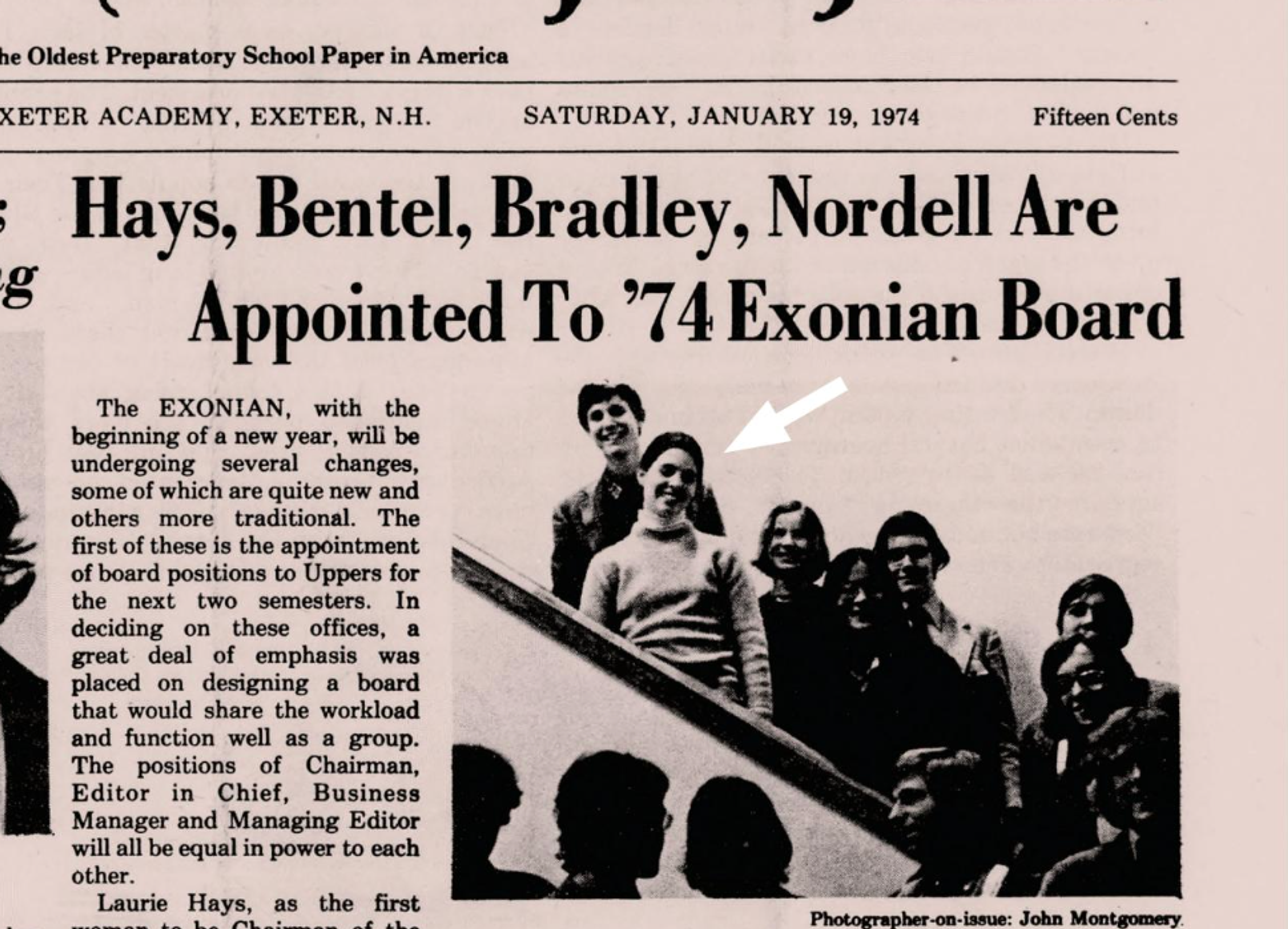
“The Secret Societies” (spring 2025) was an interesting bit of Exeter history and one I don’t believe my father or uncles knew about, first arriving in 1947. It made me wonder about other clubs which survived at least into the 1980s. The Southern Club, for example, was a club defined only by a regional criterion. This was an important association for a minority of students who were often mocked for their accents and what those apparently implied in the minds of other students about our intellect. A review of PEAN photographs point to the ubiquity of the Confederate battle flag, highlighting a show of pride by that minority. (The flag was not then so closely associated with hate groups.) I imagine now that use of the flag is no longer permitted.
I know of at least one Black classmate who is embittered by actual or perceived racism that was not and still has not been satisfactorily addressed by the Exeter community as a whole. Transparency about this history would probably be a good exercise as we recognize how we have all changed the last 50 years.
Wes Edwards ’82
The Bulletin is one of four alumni magazines I get, and I can say that it is the best of the lot. Twenty years as class correspondent (“Recorder of the Ages”) certainly deflated me a bit. Nice article. Also, since my 31-year-old son just recently was identified as “on the spectrum,” the article on autism (“Searching for a Cure”) was also amazing.
Tom De Lancey ’71
“Searching for a Cure” (spring 2025) sums up my experience of being autistic in the first phrase: “For parents of children with autism.”
Not all autistic people want to be “cured” regardless of what our parents, spouses, bosses, children and others may want.
Autism is a spectrum disorder in that it affects every individual as uniquely as our fingerprints. Some of us struggle with sensory challenges, some of us struggle with language, some of us struggle with socialization, and all at varying levels. I think it’s great to search for ways to ease these challenges, whether it’s easing dietary challenges with probiotics, using mental health therapy to teach emotion regulation or social skills, using occupational therapy for addressing sensory needs or, most important, building social supports that make the disability less disabling systemically.
We have challenges and we can benefit from supports, but many of us see the world in wholly different and beneficial ways because of the way our brains are wired. I personally would love to have fewer challenges with eating (I have a common co-occurring diagnosis of ARFID, an eating disorder, which anyone who ate dinner with me in Elm or Wetherell would probably recognize from my surviving almost entirely on breadsticks during my time at Exeter). But I wouldn’t trade the benefits I get from my autism (pattern recognition, high levels of empathy and perspective taking, high interest and focus, among others) for anything in the world.
Stephanie Lane ’12
“I was surprised as I was reading through the Bulletin to see the photo on Page 18 and my name and class in the caption (“All Aboooooard!,” spring 2025). May 16, 1942, was a Saturday. As I recall, it was the day of the Southern Club’s annual Spring Ball to be held that evening in Thompson Gym.The photo was taken after the Boston & Maine train from Boston had just stopped before opening the car doors to discharge a bevy of lovely young ladies from sundry schools and colleges in the Boston area (and perhaps beyond). Those Exonians expecting dates were anxiously looking for their gal to step out and down from the train.Why I took the picture, I do not know; but there it is.”
—David Nimick ’42
I was deeply troubled by the piece on James Adams (“Searching for a Cure”). That title reverberates in my psyche, given the hurtful, eugenic rhetoric from RFK Jr. and his ilk. Your piece parrots those tropes: that autism is a scourge, a terrible tragedy, and a heartbreak for the families of autistic people.
I am autistic and this kind of language hurts me. Autism is central to my selfhood, and is not somehow extricable from who I “really” am. It’s not a disease I have. It is an extraordinary way of being in the world and, at the same time, it is a very painful and hard way to be, in a world that is not, in any sense, built for people like me.
There are many good sources of information on autism that are run
by autists, including The Autistic Self-Advocacy Network and Neuroclastic.
We are not sick. We have always existed. A world without us in it would be an inferior world.
Sarah Courchesne ’98
We want to hear from you! The Exeter Bulletin welcomes story ideas and letters related to articles published in recent issues. Please send your remarks for consideration to bulletin@exeter.edu or Phillips Exeter Academy, The Exeter Bulletin, 20 Main Street, Exeter, NH 03833.