Dog Days
Acclaimed novelist Paul Yoon ’98 talks with English Instructor Emeritus Ralph Sneeden about his new book
By Ralph Sneeden
Fall 2026
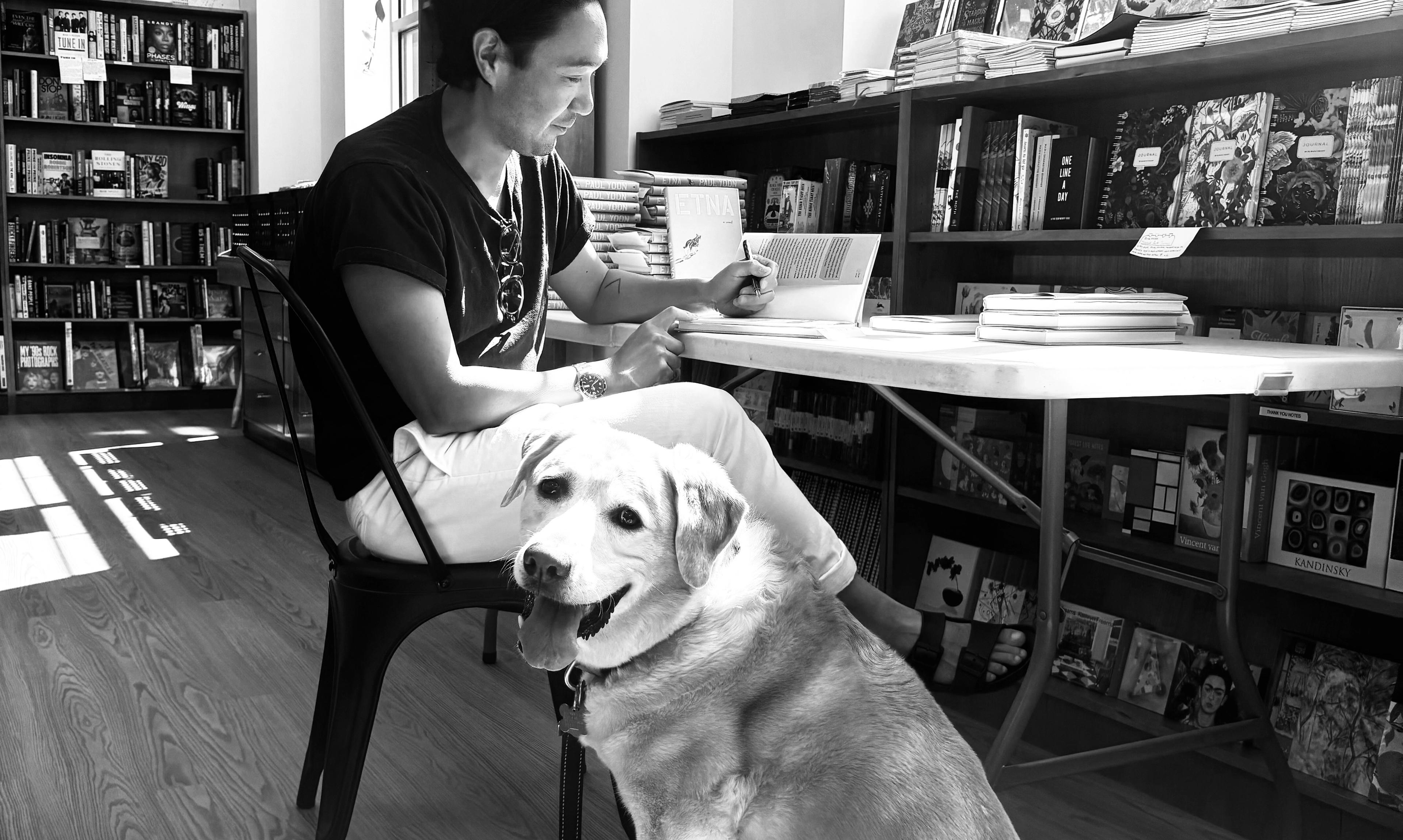
War, displacement, exile, the plight journey — readers of Paul Yoon’s work will recognize these circumstances as the forces that set his stories and novels into motion. His latest book, Etna, however, is his first attempt at approaching these themes from an animal’s perspective. Our narrative guide this time is a trained military dog whose present-day odyssey in an unnamed country is motivated by a postwar search for sanctuary, an idea of home filtered through memory and trauma.
One of the strangest and most haunting books I read recently was Tarka the Otter, written by Henry Williamson between 1923 and 1927, nearly 10 years after surviving the trenches of Ypres, Arras and the Somme. Like Yoon’s, it is not a children’s book. It’s a harrowing third-person narrative that traces the arc of a river otter’s life in England’s West Country. I admit that I enjoyed being subsumed into the otter’s physical world, but I was not expecting to think about myself. This is what great fiction — and boldly imaginative writers like Williamson and Yoon — can do.
Normally I like to savor novels while I’m reading them, to draw out the experience, put them down for a day to steep in their worlds. But it was nearly impossible to turn away from Yoon’s mirror, where an animal’s experience, its rhythm of violence, survival and poignancy is a heartbreaking commentary on humanity too. Frank Bruni underscored this recently in The New York Times, steering his weekly editorial conversation with Bret Stephens directly to Etna as “a gorgeous reminder of our ability to look searingly and soulfully at who we are and who we’ve become.”
I suspect this is why the critics’ and public’s (even non-doglovers’) reception of the novel has been panoramic, fierce and enthusiastic. I caught up with Yoon as his book tour/launch was winding down, and he was preparing to start his second year as an assistant professor at Williams College.
You experiment with an animal’s perspectivein the story “War Dogs,” which appeared in The New Yorker magazine in October 2024. Was that the first time you probed the interwoven lives and fates of people and animals?
Animals, in particular, dogs, have been pacing around my fiction for the past decade or so, mainly because a dog, Oscar, entered my life, for the first time, about 12 years ago. This might sound silly, but he changed what I notice first whenever I’m out and about: the animals we coexist with, everywhere.
“I write books because there are writers who didn’t just inspire me but shaped me and saved me.”
In Etna you dive a lot deeper, making the dog our first-person narrator. The mysteries of communication and distance we had to imagine in “War Dogs” are pulling the sled, if you will; they are the lifeblood of this new novel. What tilted you toward committing fully to this project?
Even though I never really considered myself a “dog person,” Oscar has become one of my best friends, and so I suppose it was inevitable I would eventually go “full dog.” But I wasn’t actively considering it for a longer project until I saw articles about organizations in Ukraine that re-enter areas that have been decimated by bombs to try to save as many of the animals left behind as possible. Reading about thoseheroes, something inside of me broke. It can be a beautiful thing: that we humans are at the center of this stage called life. But I think especially in the past few years, as I read about, and witness, how we treat each other and this world, and as the world enters one war after another, I felt a real human fatigue; I really needed a break from humans. I started to wonder what would happen if I pushed us aside on the stage. And I happened to look down at my 12-year-old, 75-pound Labrador’s paw on my lap, and things started to take shape from there.
I noticed that you cite John Berger’s book Kingas an inspiration in the notes section of Etna. I recall that Berger’s work has fueled your aesthetic and your writing life — the Into Their Labours trilogy, Lilac and Flag, specifically. I’m also thinking about his influential 1977 essay “Why Look at Animals?” which addresses the diminishment and exile of animals. Other than its being a story about a dog, what is it in King and perhaps across Berger’s work that you’re channeling, paying tribute to, responding to?
Once in a while, a writer just hits you, you know? It’s like they found some secret window into your heart and you feel everything. And Berger did that for me, in my early 20s. I love how resilient his characters are. No matter the circumstances, they persist and endure and fight and find moments of joy. I also think Berger was one of the first writers I encountered in adulthood where there was often a magical element in the work: A ghost could wander into the story and the matter-of-factness of his prose style —this is how it is, dear reader! — allowed me to fully commit to the world. Or a novel could be narrated by a dog and you’re fully in it. I also love his love of the natural world, and the genuine heartbreak he was able to capture in terms of how we are actively destroying it. I was thinking of all this while writing Etna. I write books because there are writers who didn’t just inspire me but shaped me and saved me. Even though I never got a chance to meet him, I wanted to acknowledge what his writing did for me: He made me want to be a better human. In the same way that having Oscar in my life makes me want to be a better human.
Your personal essay about Oscar in Alice Hoffman’s anthology (The Best Dog in the World: Essays on Love) was really moving ... and also a flirtation with a new genre, nonfiction. It’s an essay about him, but it’s about you, too, your relationship with your parents. Did writing Etna give you permission to try something new, or was it the other way around?
It was the other way around. I think writing nonfiction for the first time, weirdly, gave me the courage — or opened a door — to try something totally new to me. I don’t really write nonfiction. I love reading it — and I love reading your essays, Ralph — but I have no interest in writing in that genre. When I build a story, my go-to is the realm of fiction. But Oscar has always been a deep mystery to me — and with that has come deep love — and so when I was asked to contribute to that anthology, I gave it a shot.
What else came from opening the door to nonfiction?
Trying out that new form gave me the courage to try another new form, which was creating an animal narrative — or a narrative that completely repositions point of view. One that, I hope, nudges us and says, “Hey, humans, stop and look around.” A narrative which, I have to say, felt insane even as I was writing it. Who would want to read this? Would theyfind value in this? I truly believed in this project but I was definitely scared that I had leapt too far — that no one would take it seriously, even though I was taking it very seriously. But I think in that fear and insanity, there was a danger in what I was building that felt raw and real and mysterious and creative and inspiring. And so I kept at it, with Oscar asleep beside me on the couch, every afternoon, until I finished the book.
Ralph Sneeden has written two books of poetry and a collection of essays (The Legible Element), and has published new work in The Sewanee Review. He taught English at the Academy from 1995 to 2022.