5 Iconic Exeter Classes
Our nonexhaustive, highly subjective list of courses that make an Academy education like no other
By Sarah Pruitt '95
Illustrations by Sally Waite
Fall 2026

You may have noticed that the word “iconic” pops up everywhere these days, including in restaurant reviews, celebrity fashion coverage and K-pop hits. It got us thinking — what makes an Exeter class iconic?
Some might say longevity: tried-and-true course offerings that have remained popular and relevant for students over generations. Others might say difficulty: classes that cram two years of study into one or require herculean feats of research, writing, revision, problem-solving, analysis or all of the above. Many might say that great teachers, and the charisma they bring to the Harkness table, are what truly make classes iconic. Or they might be classes whose topics are so unusual, you could find them only at Exeter.
We took all of these definitions into consideration, and what follows is our nonexhaustive, highly subjective list of five iconic Exeter classes. They bear little resemblance to each other, yet they each represent what makes Exeter courses stand out among peer institutions’ offerings, making them — in our opinion — worthy of celebration.

BIO485: Marine Biology
The relationships and interactions between marine organisms and their environment are studied in class and in the field. Field trips to estuarine and rocky intertidal habitats allow students to become familiar with organisms and to employ techniques often used by marine biologists.
This long-running course checks all the boxes for icon status — particularly because it expands the traditional classroom and immerses students in the rich natural landscapes just a short drive from Exeter’s campus. New Hampshire’s Atlantic coastline might be the shortest of any state, but we make up for it with more than 235 miles of tidal estuarine shoreline along the state’s bays and rivers — all teeming with marine life waiting to be explored.
Instructor Emeritus in Science Rich Aaronian introduced Exeter’s first marine biology course in the 1970s (along with an equally iconic course in ornithology), and the class is still going strong today. Students in BIO485 ride in the famous “Red Dragon” vans on excursions to tidal pools at Odiorne Point State Park in Rye, mudflats and salt marshes in Hampton and Seabrook, estuaries such as Great Bay and dune systems at Plum Island. They also explore organisms attached to the floating dock at the Coastal Marine Laboratory in Newcastle, operated by the University of New Hampshire, and take boats from Saltonstall Boathouse down the Squamscott River to collect plankton.
“I notice things like the organisms feeding on the seaweed, and a crab scurrying for shelter underneath a rock to maintain the moisture on its gills. I see a whole world operating beneath my feet that went unnoticed until I took this class.”
—Luvy Danielson '27
“One of the common themes in marine biology is zonation, and how the abiotic environment — the physical environment — affects where organisms live,” says Science Instructor Sydnee Goddard. “We measure the physical environment, and we collect organisms, and then talk about it. I think it’s nice for students to see what is living in their backyard.”
From these excursions, students bring back organisms such as worms, mussels, crabs, snails and algae, which are kept alive in a cold room and a wet table with circulating seawater. These organisms are used not only in BIO485, but also in introductory biology courses studying the diversity of life. In addition to their numerous off-campus adventures, students use the 90,000-gallon coral reef tank in the lobby of Phelps Science Center to study how different types of coral function in a reef environment (albeit on a tiny scale).
Despite living less than a mile from the beach in Rye, Luvy Danielson ’27 came to view the seacoast region in a whole new way after taking BIO485 last year. “Now when I walk down to the beach, I notice things like the organisms feeding on the seaweed, and a crab scurrying for shelter underneath a rock to maintain the moisture on its gills,” Danielson says. “I see a whole world operating beneath my feet that went unnoticed until I took this class.”

ENG500: Senior English
In the final sequential course in the English curriculum, writing assignments continue to focus on various forms of essay writing, culminating in a sustained exploration of a topic or theme — the Senior Meditation or an equivalent capstone assignment. Readings continue to grow in complexity of subject matter and style.
Where Exeter’s History Department has the mighty “333,” English has the senior meditation. While not technically a required common assignment in the English Department, writing a meditation — defined as a “sustained exploration of a topic or theme” relating to personal experience — has for decades served as the capstone of a student’s Exeter English studies. Though the timing of the assignment has varied, current students now write their meditations in the fall term of senior year in ENG 500: Senior English.
Virtually every senior is required to take ENG500, and nearly half of all instructors in the English Department teach at least one section. Reading assignments are up to the teachers; some assign past meditations or other personal essays, while many choose William Shakespeare’s Hamlet, an ideal (if tortured) model for the self-investigation students must do in their own writing. “The first line of Hamlet is, ‘Who's there?’” says English Instructor and Steyer Distinguished Professor Brooks Moriarty ’87. “That's the question the students are asking of themselves.”
“It’s called a meditation, but it’s also kind of meditative to write.”
—Owen Welch '26
Writing the senior meditation is only part of the challenge, however. It is designed to be delivered orally, in front of classmates or even a larger audience of community members. Around 20 to 25 students are selected to read their meditations on Wednesday mornings in the winter and spring terms at Phillips Church and Multifaith Center. The selected meditations are also collected and published annually, thanks to a fund established for that purpose to honor the life and memory of Shannon Nissa Bailey Powers ’97, who died of complications of cystic fibrosis in 2003.
“By their senior year, students have moved through a lot of personal narratives; they've moved through a lot of analytical essays,” says Woodbridge Odlin Distinguished Professor of English Todd Hearon, who directs the meditation program. “The meditation gives them the opportunity to combine the two in a kind of self-searching way, where their own life becomes the text and their own story becomes preeminent.”
Owen Welch ’26, who delivered his meditation in Phillips Church last spring, was accustomed to completing big assignments at the last minute — even his 333 — but he had a different experience in ENG500. “The meditation was just so fun to write that I just plugged away at it whenever I had a free moment,” Welch told The Exonian last spring. “It’s called a meditation, but it’s also kind of meditative to write.”

Mathematics 3-4
OK, this is not actually a class — it’s a set of problems (837 problems, to be exact) that form the backbone of the distinctive curriculum known as Exeter Math. This collaborative, discussion-based learning method explores a series of themes that weave throughout the math courses each student takes, including optimization, symmetry, parametric motion, vector thinking, mathematical modeling and more.
Mathematics 3-4, the third problem set in the series, covers topics in precalculus andtrigonometry as well as more advanced ideas found in calculus, linear algebra and multivariable calculus. Most students encounter the problems in their third year studying math at Exeter, but their entry point varies. “Math 330 is the last course that is a graduation requirement, so pretty much everybody takes classes that are in our Math 3-4 book,” Math Department Chair and Raymond W. Ellis Distinguished Professor Panama Geer says.
Since the department began using Exeter Math in the late 1990s, thousands of Exonians have been introduced to the various memorable characters — all with gender-neutral names — who populate the problem sets. There’s Alex the geologist (who appears in Math 1-2 and later in Math 4-5), who’s in the desert and wants to know the fastest route to buy an ice-cold Pepsi (optimization). Or Pat and Kim, who are talking on the phone during a thunderstorm, and hear the thunder both through an open window and through the phone. “Basically, the problem develops real-world geometric understanding of the concept of a hyperbola,” Geer says.
“We care a lot about creating classes where kids feel like they can be confident.”
—Panama Geer, Math Department Chair
Students over the years have embraced the characters, even dressing up as “Alex the geologist” for Halloween. But Alex, Pat, Kim and the rest of the crew are only part of what makes studying math at Exeter unique. It’s also the personalized curriculum, and the fact that students are always being evaluated to ensure they’re at the right place in their studies.
“We care a lot about creating classes where kids feel like they can be confident and thrive in the material,” Geer says. “They’re all integrated topics, so it’s not really about where you start. It’s just what you're ready for at a particular time.”
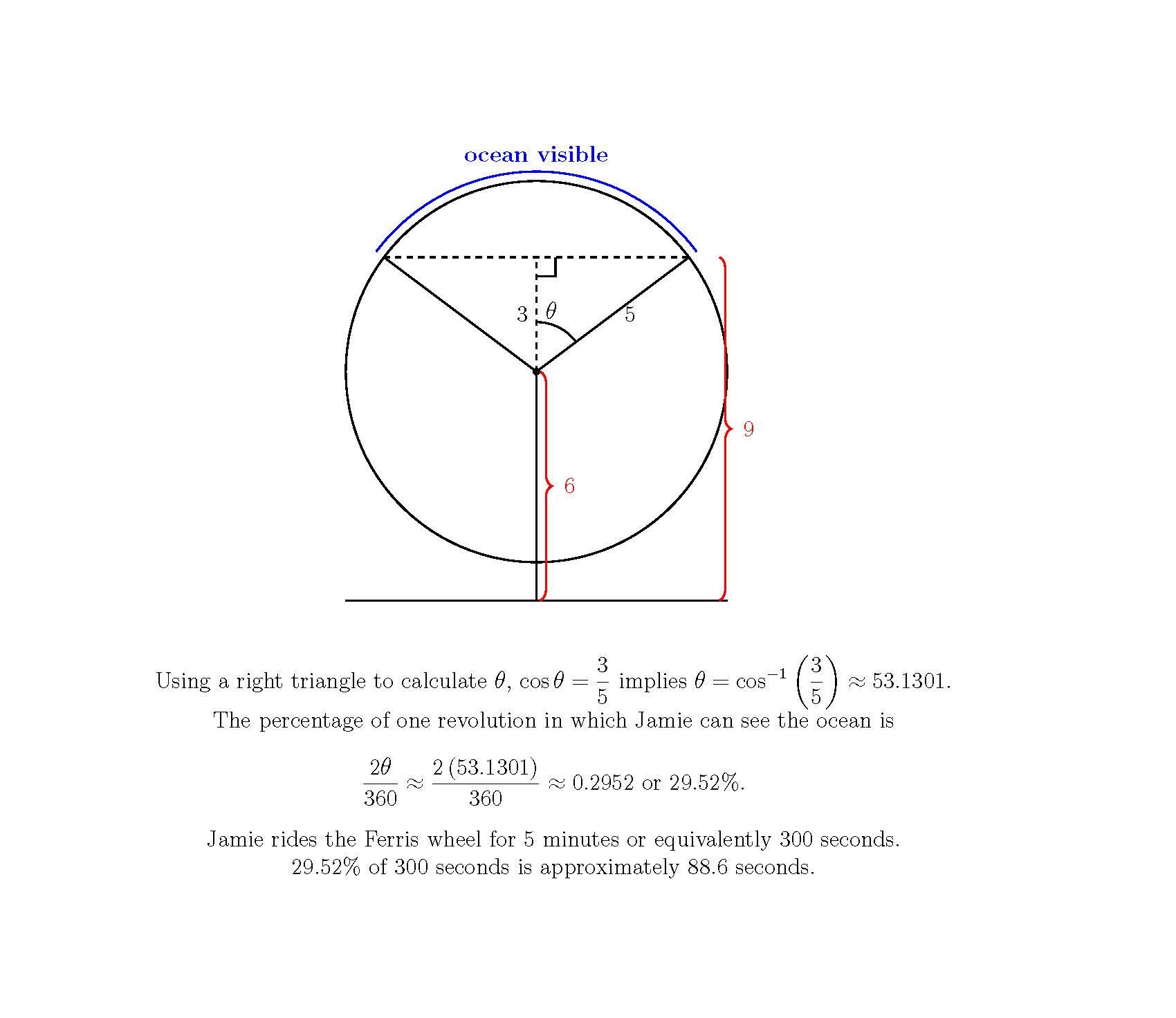
Test yourself: Math 3-4, Problem #112
Jamie rides a Ferris wheel for five minutes. The diameter of the wheel is 10 meters, and its center is 6 meters above the ground. Each revolution of the wheel takes 30 seconds. Being more than 9 meters above the ground enables Jamie to see the ocean. For how many seconds does Jamie see the ocean?

CHE411/421/431: Accelerated Chemistry
This course is designed for those students who have not had a previous full-year, laboratory-based chemistry course. Because this course covers two years of chemistry in three terms, students should expect that this course will progress at a more rapid pace and demand a greater degree of independent study than the typical one-year science course.
Designed for students who prefer their learning to go at warp speed, CHE411/421/431 takes two years of chemistry studies — from basic molecular structure through kinetics and all the way to advanced electrochemistry — and packs them into one. Given the punishing pace, it’s not surprising that current students refer to the sequence as “Death Chem.”
“The name is not accurate — nobody dies, of course,” Science Instructor and Steyer Distinguished Professor Albert Léger says. “It’s fast-paced, it’s exciting. The sense of discovery is way high because every day is something new.”
To enroll in the class, students go through an application process, including demonstrating a high level of physics and math proficiency. When spring comes, they will be prepared to take the AP Chemistry exam — after only three terms of study. “I still take time for them to help each other,” Léger says. “But they all understand that they need to keep up.”
“It teaches you to study in completely new ways, independent of memorizing or senseless grinding. The class really rewards a good, intrinsic knowledge of the process, rather than just how you get to the answer.”
—Sofie Salen, '27
Sofie Salen ’27, who took Accelerated Chemistry last year, enjoyed the collaborative lab-focused format and pace of the class. “It teaches you to study in completely new ways, independent of memorizing or senseless grinding,” Salen says. “The class really rewards a good, intrinsic knowledge of the process, rather than just how you get to the answer.”
For Léger, challenging students to grow in new ways — while giving them the necessary support from teachers and peers — is what makes this intimidating course so valuable. “For some of these students, it’ll be the first time they struggle,” he says. “They learn to push through, to ask questions, and to understand that it’s OK to struggle a little bit and not get it perfect the first time. That’s bigger than chemistry.”

Field Courses (999s)
Qualified students who have exhausted the related course offerings in a particular discipline may petition to add a field course as part of their program. Field courses involve advanced and, in appropriate measure, independent study in a field of special interest and competence.
Though Exeter may offer more than 450 courses, some students still want a little something … extra. The Academy’s Courses of Instruction defines a course with the number 999 as “an independent field course or tutorial.” What that means, essentially, is that, once their diploma requirements are fulfilled, Exeter students can follow their academic interests and passions as deeply as they want to.
Other high-level courses at Exeter — 590s, 690s, 700s and the like — are dictated by what a teacher wants to teach, or what a department wants to offer to fill out its curriculum. By contrast, 999s are the ultimate in student-directed learning: a small group of students, or even a single student, working with one instructor on a subject of their choosing. Science Instructor and Director of Studies Jeanette Lovett says, “590s are typically teacher-driven, while 999s are very much student-driven.”
To undertake a 999, students must petition the dean of faculty, prepare a course content proposal and get the instructor, adviser and department chair to sign off. Sometimes 999s grow into permanent additions to the Academy’s course catalog. Two popular biology electives, BIO588: The Genetic Basis of Cancer and BIO650: Malaria: Exploring Bioinformatics and Next-Generation Sequencing, began as 999s.
These courses are not for everyone. Only a small percentage of students who graduate from Exeter will complete a 999. But those who do may find the course one of the most rewarding of their time at the Academy.
Last winter, eight students took THR999, a field course in advanced musical theater performance. Co-taught by Theater and Dance Instructor Lauren Josef and Kris Johnson, Michael V. Forrestal, Class of 1945, Chair for the Department of Music, the course gave students a deeper understanding of ways to act effectively while singing and how to bring meaning to the music — lessons they channeled into a performance at the end of the term.
Ezequiel Martinez ’27, one of the students who developed the idea for the class, was inspired to keep his musical theater training going after earning his first principal role in an Exeter production. “The 999 class was the perfect opportunity to push myself further,” Martinez says. “Its design allowed us to explore standard audition pieces while diving into song selection and acting while singing. It felt like a college-level course.”
Sarah Pruitt ’95 is a senior writer-editor at Exeter and a staff writer for The Exeter Bulletin.