Colin Franklin Newell Irving ’41; ’65 (Hon.)
Treasurer and Instructor in History, Emeritus (1924-2025)
Summer 2026
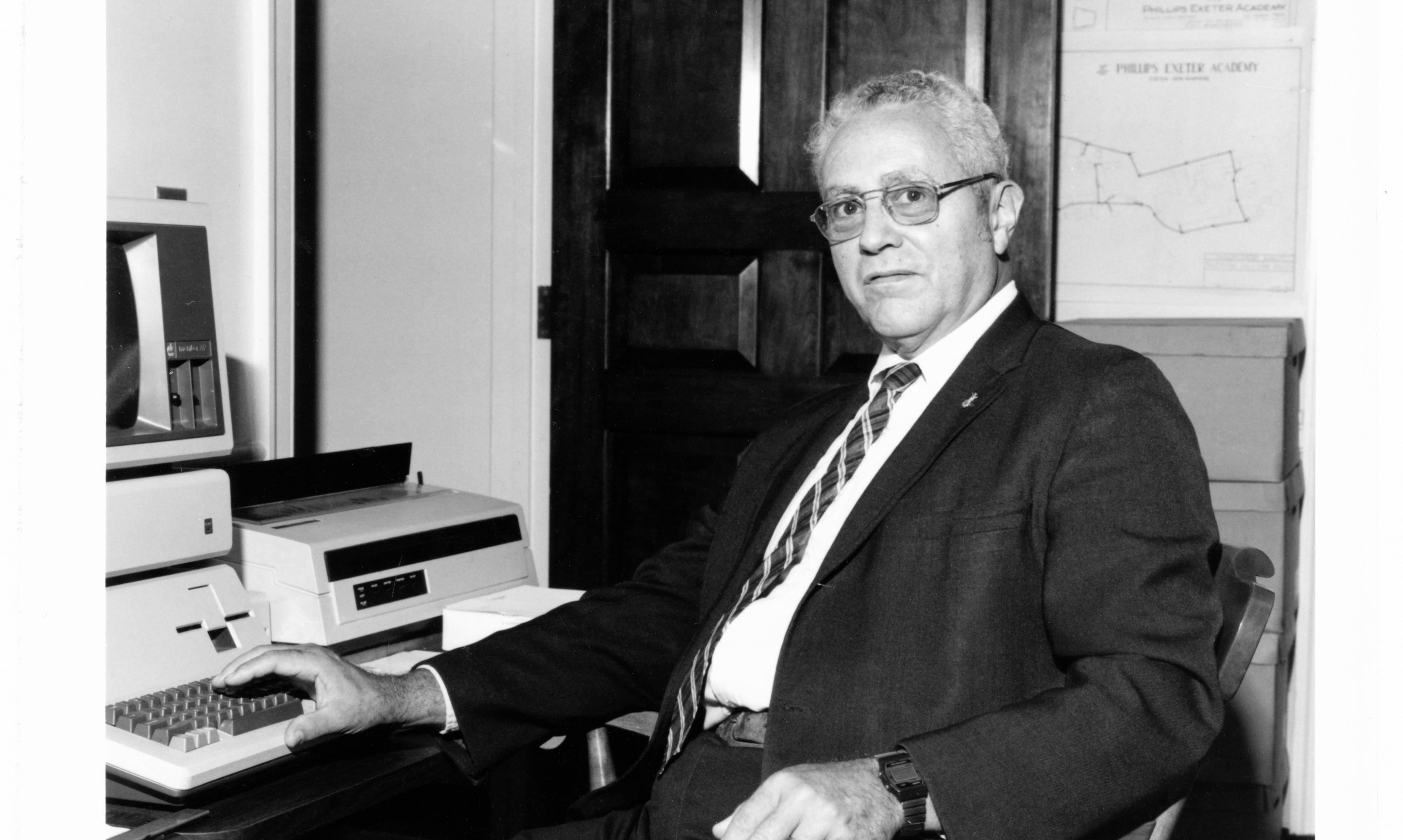
To anyone who didn’t know Colin Irving and his 40-year career at Phillips Exeter Academy, it might seem unusual that, in his job acceptance letter to Principal William Saltonstall, he would comment on the outrageous size of the bathroom in his apartment in Cilley Hall. Yet Colin’s observation was merely a prophetic note with regard to his future role at the Academy, one that would take him from the history classroom to overseeing, as treasurer, operations of the entire physical plant, including all the bathrooms, and so much more.
Colin’s history with Exeter began in the fall of 1939, when he entered the Academy as an upper middler. He particularly enjoyed debate, and The Exonian reported many in the PEA Senate being led by one Colin Irving. This included his victory in the spring of 1941 on a resolution to pass the Lend-Lease Act, Colin arguing the affirmative. One wonders if in later years he looked back fondly on that victory, his chief opponent being Gore Vidal.
After receiving his classical diploma, he entered Harvard, though with the advent of war, he left for the United States Army, where he served as cryptographic specialist from 1943 to 1945. Upon returning to Harvard, he completed his studies in history and Slavic studies, graduating with distinction in 1946.
That fall, Colin joined the History Department at the Academy, where, except for a brief return to Harvard for an M.A. in history, he remained until his retirement in 1986. Early on, it was apparent that his impact would be distinctive. He once said, in a letter to Saltonstall, that Exeter could become a great school if it offered “a climate for dramatic experimentation.”
He led by example. In 1958 he began teaching the Russian language informally, then a year later, introduced a course in Russian history, the first in any independent school in the country. In his proposal, Colin argued for the merit of such a course beyond its obviously great topical appeal. Lamenting the dangerously superficial treatment of a current events approach to the subject, he intended to supplement the narrative history of Russia with Russian literature and music, seeing both to be avenues of political expression.
His students appreciated such a sophisticated approach. Parker Jayne ’65 recently wrote that though he had many great teachers over the years, Colin had the most impact on his life. Having taken his Russian History class, Parker commented that “one left his class having experienced intellectually and emotionally how literature and the arts reflect a country’s history.”
Unable to satisfy his students’ interest in Russian literature, Colin agreed to host a seminar at his home where they would gather, in Colin’s words, “around the samovar.” One of the attendees, Terry Goddard ’65, said, “Colin Irving treated us not as students but (whether we deserved it or not) as fellow intellectuals having a discussion among colleagues.” Perhaps not surprisingly, Terry described those gatherings as “the high point of my years at Exeter.”
Aside from his teaching assignments, Colin fulfilled the other duties of a triple-threat instructor, coaching club crew for 15 years and club soccer for five, in addition to serving in Cilley, Sleeper and Lamont dormitories for another 20. Soon other offices began seeking his talents, Pike Rounds enticing him to serve part-time in the Admissions Office and the administration appointing him director of the Summer School from 1961 to 1965.
In this role, Colin acted with vigor to ensure that Exeter would be true to its principle of being a school open to “youth from every quarter.” In a letter to Principal Richard Day, he proudly noted the dramatic increase in African American students and staff in the Summer School. When an alumnus wrote to the Academy protesting the excessive number of such students in pictures in the recent Bulletin and threatening to withhold support if the Academy continued in such a direction, Colin objected. While pointing out with detailed statistics that indeed, the Bulletin’s visuals accurately reflected the Summer School’s racial diversity, he urged the school to proudly champion the initiative that made it so.
Colin’s goals for improvement of the Summer School included more than increasing its racial diversity. In 1962, he enrolled the first boarding girls in its summer programs. By the time he left that position three years later, the enrollment of girls had increased to 110 from 13.
When the Academy later fully embraced coeducation, Colin spoke forcefully about its responsibilities for having done so. In 1972 he wrote to the administration urging the hiring of a greater number of female employees as well as proposing an initiative to achieve gender equality of pay and benefits. Thinking that these suggestions might meet with some resistance, he added that not doing so would “put us in violation of Title VII of the Civil Rights Act.” One sees here Colin anticipating the direction the school would take in the years ahead, and one can also see him being somewhat in the lead in that regard.
During these years Colin also kept busy leading Exeter’s adult education program. Offering courses annually to citizens of the town, who numbered as many as 500 enrollees, he believed in Academy outreach to the greater Exeter community. This included his service to Exeter Hospital as its treasurer. He also served as president of the Association of Business Officers of Preparatory Schools and as president of the Independent Schools Association of Northern New England.
Competence in these administrative duties led to Colin’s appointment as executive assistant to the principal from 1965 to 1967, as well as acting comptroller during that time. Yet it was his appointment as treasurer in 1967, a post that he held for the next 20 years, that enabled Colin to establish a reputation for competence and versatility, talents that enriched the school.
As treasurer, his responsibility included the entire physical plant, all 1,400,000 square feet of it, and the 600 acres of Academy grounds. Yet for Colin, the duties of the Academy treasurer were significantly expanded to include oversight of the changes brought about through two major capital campaigns: the Long Step Forward in the late 1960s and the Third Century Fund in the late 1970s and early 1980s.
From his first days in the office, Colin was central to carrying out the major construction projects undertaken by the Long Step Forward: the new Love Gymnasium, the Kahn library, Elm Street Dining Hall, Fisher Theater and two new dormitories. One need read but a few of the abundant memoranda, sent to faculty and staff, as well as to Trustees, architects, construction managers and others, signed C.F.N.I., Colin’s shortened signature, to realize the range of issues being tended to by his watchful eye.
Principal Stephen Kurtz, in acknowledging Colin’s contribution to the school, marveled at his expansive knowledge of budget detail, underground pipelines, telephone networks, computer needs and application, insurance policy provisions and food service problems. It was through Colin’s foresight that the Academy undertook the infrastructure upgrade needed to enable the school to apply computer systems to the business and academic needs of Exeter, more evidence of Colin’s vision in anticipating the future of the Academy.
In addition to the added chores arising from capital campaigns, Colin had to deal with very lean years as well. Consider that between those fundraising campaigns, the 1972 endowment of $72 million, due to a significant recession and a serious energy crisis, plummeted to $43 million by 1978. Colin’s budgets had to accommodate such a decline, leaving him to say at the time, “I see nothing ahead but anguish.” Yet deal with it he did, helping the Academy overcome those lean years and prosper significantly by the time he left office in 1986.
One wonders how degrees in history and Slavic languages prepared Colin to take on such responsibilities. Those who worked most closely with him simply explained it as a mystery which, Kurtz said, accounted for their nickname for Colin, Merlin.
Though reaching the century mark in one’s life as Colin did is notable, surely for him 62, connoting the years of his marriage to his wife, Frankie, would be the much more important number. Together at Exeter they raised four children, Pamela, Sara, John ’61 and Steven ’72, all of whom no doubt saw him as much more than a magician. Indeed, John, in writing of his stepfather Colin’s passing, noted that in all his novels, stepfather characters always exhibited heroic qualities, as Colin did to John and his siblings. Being both a magician and hero, Colin left important legacies to both this school and his family, for which we are greatly indebted.
The Memorial Minute excerpted here was written by Jack Herney (dean of faculty, Robert Shaw White Professor in History, chair of the Department of History and director of Admissions and Financial Aid emeritus), Susan Herney (senior associate director of admissions, associate director of admissions, dean of students, associate dean of students, associate director of major gifts, director of stewardship for major gifts and assistant director of capital giving emerita), Joseph Fellows (counselor, treasurer and chief financial officer emeritus), Bruce Pruitt (Steyer Distinguished Professor in History, Cordingley Teaching Chair in History, Bicentennial Professor in History, director of studies and chair of the Department of History emeritus), Andy Hertig (Independence Foundation Professor, chair of the Department of History, dean of faculty and instructor in history emeritus) and Rick Mahoney ’61 (former admissions officer, basketball coach, associate dean of students, dean of students, associate director of Admissions and Financial Aid and director of Financial Aid). The full remarks were presented to the faculty at its meeting on January 20, 2026.