Forward, Together
Jenny Elliott begins tenure as 17th principal, ready to lead Exeter's next chapter
By Patrick Garrity
Fall 2026
Three hours before the biggest speech of her professional life, Jenny Elliott, Exeter’s new principal, was feeling the heat.
To be fair, it was the heat of the room, not the moment, that had raised her heart rate. She was at a yoga studio in downtown Exeter, the thermostat set to 98 degrees, doing her best to get some elevation on her three-legged dog pose. Sweat is the currency of hot yoga.
That Elliott was up before the sun trying to master utkatasana and anjaneyasana ahead of her first Opening Assembly address will surprise no one who grew up with her, studied in her classroom, worked alongside her or simply crossed her path. Elliott’s preferred gear is fifth. Getting up to speed in her first year at the Academy is not a worry. Rather, where she steers is her primary focus in these early days of her principalship.
“It’s fun being with so many sharp, motivated, capable people in such strong teams, and imagining the possibilities,” she says. “I think harnessing and probably trying to be more disciplined about our strategy and what we can tackle [is most important]. We're trying to get clear on what our goals are and how can we pursue them doggedly without trying to take on too much.”
Named last November as Exeter’s 17th principal to follow the eight-year tenure of Bill Rawson ’71; ’65, ’70 (Hon.); P’08, Elliott takes charge of an institution in excellent health by every meaningful measure amid the uncertainty of how technological advancements like artificial intelligence are hastily transforming education. As Exeter approaches the 250th anniversary of its founding, the Academy, and secondary and higher ed, are nearing a critical junction.
“This is a tremendously exciting moment for education,” Elliott says, quickly adding, “It’s exhilarating and sometimes daunting.
“It’s going to require a lot of work and reckoning and grappling. I really believe that these are some of the words we’re going to need to use to navigate the next several years.”
Elliott insists this work and her tenure will be a distinctly collective effort. She calls herself “a team player who is drawn to thorny challenges, collaborative endeavors and audacious goals, keenly aware of how much more you can accomplish when you build positive team culture and momentum around a shared mission.” President of the Trustees Kristyn McLeod Van Ostern ’96 referred to her as “a leader who listens deeply [and] collaborates naturally,” in announcing Elliott’s appointment.

Principal Jenny Elliott addresses the community during Opening Assembly at the start of the 2026-27 academic year.
Eimer Page, Exeter’s assistant principal, spoke of an administrative team retreat during the summer, when Academy leaders got their first glimpse of working with their new boss.
“She encourages her team to reflect closely on our strengths and to pay attention to patterns and blind spots that might cause us to overlook perspectives, forge ahead without considering nuance or miss an opportunity to offer a better pathway,” Page says.
At least one former colleague believes the “team player” now occupying the principal’s office in Jeremiah Smith Hall is a genuine superstar.
“In baseball, there is an expression of excellence: the five-tool player,” says John Palfrey ’90, who worked hand in glove with Elliott at Phillips Academy when he was Andover’s head of school and she was its dean of students and assistant head of school for residential life. “They can hit for power, they hit for average, they can run, they can field, and they can throw. She is a five-tool player when it comes to living and serving at a boarding school.
“She encourages her team to reflect closely on our strengths and to pay attention to patterns and blind spots that might cause us to overlook perspectives, forge ahead without considering nuance or miss an opportunity to offer a better pathway.”
—Eimer Page, Assistant Principal
“She really did everything: She advised, she lived in a dorm, she coached, she taught, she was a dean. There’s nothing she wouldn’t do for the kids and for the community. She sets a very high bar, and others are inspired to meet it along-side her. I certainly was.”
The Other Phillips
Jennifer Karlen Elliott, 50, grew up in suburban New York City, the third of four children. She was introduced to independent schools when her older brother attended Andover.
“Boarding school was not some-thing that my family had known about or had really considered,” she says, but her brother persuaded their parents to let him go away to school. His visits home, which often included friends from school, hooked her.
“I loved the ways that he and his friends could swiftly move between serious conversations and playful conversations,” Elliott says. “And I loved the way they talked about school. They loved school. They really were into school.And I remember thinking: I’m like that. I love school.”
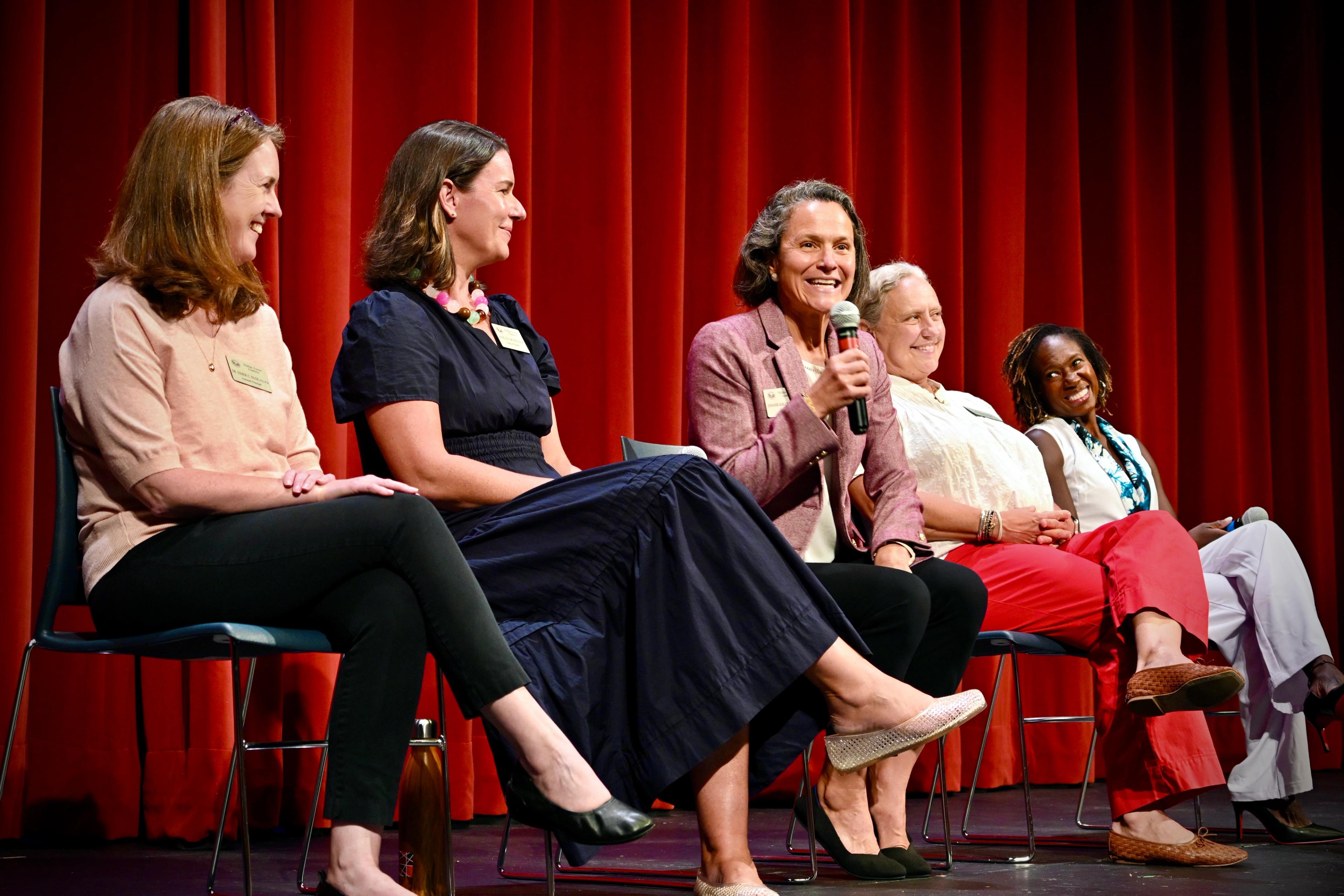
Assistant Principal Eimer Page, Dean of Students Ashley Taylor, Elliott, Dean of Faculty Meg Foley and Director of Equity and Inclusion Stephanie Bramlett
Elliott says her brother’s academic shadow was long, so she dove into the other parts of school life once she arrived at Andover as a 10th grader. She played field hockey, squash and lacrosse. She served on the board of the school’s radio station. She was earnest about fulfilling the value of non sibi, which Andover shares with Exeter, through performing and leading community service.
And she bled blue. Recounting a story at a recent student assembly about her experience as an athlete with the Exeter-Andover rivalry, she acknowledged that her field hockey team’s zeal got the best of them in her senior year.
“I shaved an A in the back of my head,” she recalled. “I had pretty long hair, and I put it up and just shaved this big old A in the back of my head. My parents were like, ‘What in the world?’ I came up here all confident that we had this strong team and showed up, and I had a huge A in my head. And we did not win that game.”
After graduating from Andover in 1994, Elliott earned a bachelor’s degree in history from Dartmouth College and a master’s degree in elementary education from Lesley University. After teaching stops at four schools, she returned to Andover in 2010, starting a 12-year run as an instructor in the History and Social Science Departments, adviser and coach and, later, as assistant head of school for residential life and dean of students. Three of her four sons graduated from Andover. (The fourth is a ninth grader at Choate Rosemary Hall.)
Elliott knows her past on the blue side of the Phillips rivalry can be awkward around her new home. In her retelling of a high school anecdote, her reference to “Andover-Exeter” games elicited groans from the assembly audience. But she is certain the schools’ common principles, enduring missions and deep mutual respect greatly outweigh any sporting feud.
“The student and the educator in me know how aligned these institutions are,” she says, “and know how much they share in terms of values and know the potential of these two institutions, that if and where these two institutions decide to push or decide to lead, what that can look like. To my mind, that's not complicated or tricky at all.”
Palfrey traveled the other direction on Interstate 495 in the hallowed rivalry, graduating from Exeter and serving as Andover’s head of school from 2012–19. “We’re at once cousins and rivals, Andover and Exeter graduates,” he says. “That means a lot — and it’s an important relationship. She didn’t go to Exeter, so she will have to learn about its special ways. But she knows about the founding values, just as family values would be familiar to cousins in an extended family.”
Elliott is absorbing the Exeter ethos.
“The exciting part for me is that there’s a lot about Exeter that is uniquely Exeter that I am getting to know and I am so appreciating,” she says. “I’m struck in every conversation how quickly my conversation partner wants to dig into substance. We move beyond superficial swiftly, and we get into thinking about enduring core ideas and values and what are the big questions we need to be interrogating. And that seems to hold if I’m talking to a new student, an alum, a former trustee or a faculty emerita — it’s a consistent pattern, and it makes every conversation engaging and interesting.”
Student Council leaders presented gifts to Elliott during a September assembly. The gifts included a traditional corn bristle broom that the students told her she will need when fall E/A arrives and she calls on Big Red to “sweep” the Blue.
“I am so behind this,” Elliott told them. “I will be delighted to sweep any floor for Exeter.”
A Principal Priority
Tackling artificial intelligence's pitfalls and potential
In setting priorities, Principal Jenny Elliott keeps high on her list how the Academy might incorporate generative artificial intelligence into the campus and the classroom. She addressed the topic during her Opening Assembly remarks and was asked about it during a Student Council conversation two weeks later.
“I think there are real risks to our learning,” she told the students, reflecting a recent MIT study that warned about signs of “cognitive surrender” as students come to rely on chatbots for answers. “I don’t think any of you, I don’t think any of us, signed up to join this community to engage in a cognitive surrender, right? That’s not what we’re looking to do here.”
The study, which Elliott distributed to faculty and her administrative team, went further, warning that an “overreliance on chatbots can have a range of significant negative consequences — diminishing critical thinking, weakening memory, eroding confidence and undermining mastery.”
The study acknowledged, however, “the potential of these technologies to augment work across campus is immense.”
These competing truths cause what Elliott calls “dissonance internally that’s really uncomfortable.”
“How do we support each other through that?” she asked the students. “I think that is the work of a school. We are fortunate that we have these student-teacher ratios in class and in advising groups and in dorms. We have these contexts and spaces to engage in these conversations. What I really, really don’t want to do is avoid this and pretend that it’s not happening.”
Elliott added: “AI is going to force us to clarify what really matters and force us to be explicit and deliberate about the skills and competencies that we believe our students need in order to feel prepared for their next chapter.”
To that end, Elliott has formed an operational AI committee to study the technology’s potential outside the classroom while tasking the faculty Curriculum Committee with specific efforts for this school year that include assessing the campus community’s current use of AI, facilitating listening sessions, promoting literacy around the platforms and developing a set of guiding principles and an institutional position statement.
“Together, we will define responsible and discerning use and grapple with the ethical, artistic, environmental, sociocultural and pedagogical challenges these technologies pose,” Elliott says. “We will rely on our values to guide our efforts. At a time when the rapid expansion of machine learning rattles our conception of being, doing and contributing, we get to uplift our most essential human strengths and build our human intelligence.”
A Perfect Fit
When Rawson announced in February 2025 that the 2025–26 school year was to be his last, the Trustees vowed to conduct an inclusive and comprehensive search for his successor. Trustee Janney Wilson ’83 headed a search committee that included other trustees and current and former faculty, and was supported by Perrett Laver, a global executive search firm.
At the time, Elliott was midway through her third year as head of student and academic life at Choate, a position she left Andover to accept in 2022. She was not necessarily looking for another new challenge so soon, but she had made a short list of schools that would tempt her should the opportunity surface.
“That set of schools had to do with values, had to do with size, had to do with resources in terms of access; I was drawn to school communities that were committed to creating access,” she says.
In considering whether to go through the application process, “It was more of a gut check of myself, like: Are you willing to put yourself out there? Are you willing to go for this? Are you willing to take this risk?” she says. “I knew it was a risk. I knew it would be something that would hurt if I didn’t make it very far in the process or if I didn’t get it.”
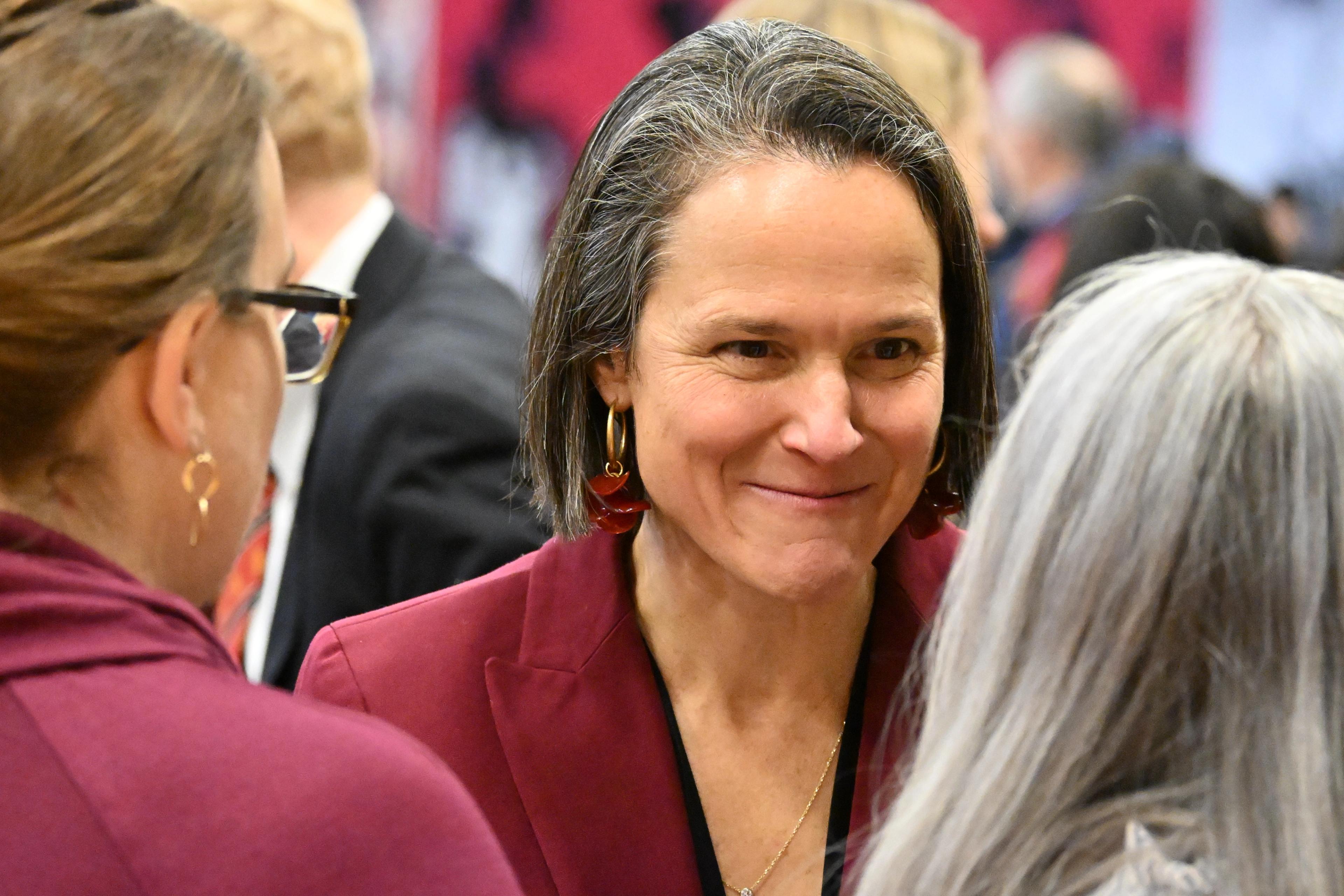
Her husband, Grant, knew of her admiration for Exeter. So did her boss, Choate Head of School Alex Curtis. And Palfrey, a mentor, was certain she was the right person for the moment.
“I told her that her incredible skill set, her lived experiences and all that she has done to prepare was exactly what I thought Exeter needed in 2026,” Palfrey recalls.
Elliott says, “I texted John immediately, and he reminded me: ‘Well, you’ve been talking the talk for some time. Let’s go. You’ve got to go for it.’"
Exeter’s search connected the committee with over 400 educators and included conversations with members of the Academy community — faculty, staff and alumni — about what they believed were priorities to consider in choosing the school’s next leader. Elliott says she came to appreciate that the search committee “was asking and listening to understand the needs of its community.”
She adds: “What I committed to myself was I was going to be entirely transparent and authentic in that process; I committed to being clear about who I was, what I cared about, what I wanted to do, so that at the end of the day, whether I was hired or I was not, I could feel good about giving the hiring committee an opportunity to make an informed decision. And if it was a match, I could know: All right, I’ve been really straight up with you about what I care about. I don’t have to be somebody else.”
What she cares about most are students. She told them at Opening Assembly: “I delight in young people. You are the source of my optimism and the very best part of my work. You are the very best part of this community.”
She displays those sentiments in every campus interaction. She spent move-in day in September on an hours-long loop around campus, visiting dorms and saying hello to each student and family she found. She beat the sun to Phelps Stadium last month, snapping photos before dawn with groggy teens at the senior sunrise gathering. When a student recently fell ill, Elliott was one of the first to hop in her car to visit the hospital. She told the students they can expect to find her studying alongside them as she works to complete her doctorate from Vanderbilt University, and she plans to host students regularly at her residence, Saltonstall House.
“I delight in young people. You are the source of my optimism and the very best part of my work. You are the very best part of this community.”
—Principal Elliott during Opening Assembly
She leads with a smile that is impossible not to return, and she gives each stu-dent her undivided attention. That quality will make her late for appointments but on time for the adolescents in her care.
“She has so much experience that parallels theirs — a boarding student her-self who juggled sports, clubs, dorm life, friendships, family expectations, leadership and academics — that she can speak in ways that feel genuine and insightful,” Page says. “Hearing her talk about having PGs over at her house, or hosting affin-ity groups, or seeing her show up at the football game with her dog, I can see that working with students gives her genuine energy and joy.”
Elliott appreciates that she is the principal to all Exonians — present and past. Working as a dean of students or a history teacher did not include that responsibility. The Academy has more than 23,000 living alumni, each with a different Exeter experience, many with their own ideas for what the school needs. Elliott values that connection and the wisdom that comes with it. She also understands that she must lead the school as it exists today, with her attention ultimately on the students entrusted to Exeter and the questions they are asking now.
Hard, Not Harsh
Elliott says caring for students’ needs is not in conflict with Exeter’s renowned rigor. She knows that every student who applies for admission seeks a challenge. Academic excellence will remain a tenet of the Exeter experience, and A’s will remain hard to come by. “Here at Exeter, we dream big, we aim high and we work hard,” she told the Opening Assembly audience.
She added that any tension between fostering excellence and promoting well-being is born out of a misperception that excellence implies perfection.
“There’s a difference between hard and harsh,” she says. “I want our kids to know that; to graduate from this place being like, ‘I have looked hard in the eyes, and I know I can do this.’ But I also want them to know that when hard comes, they don’t have to do it by themselves. I don't know many grown-ups who do it all by them-selves. It’s foolish to believe you should do it all by yourself. I want our kids to learn that early and not the hard way.”
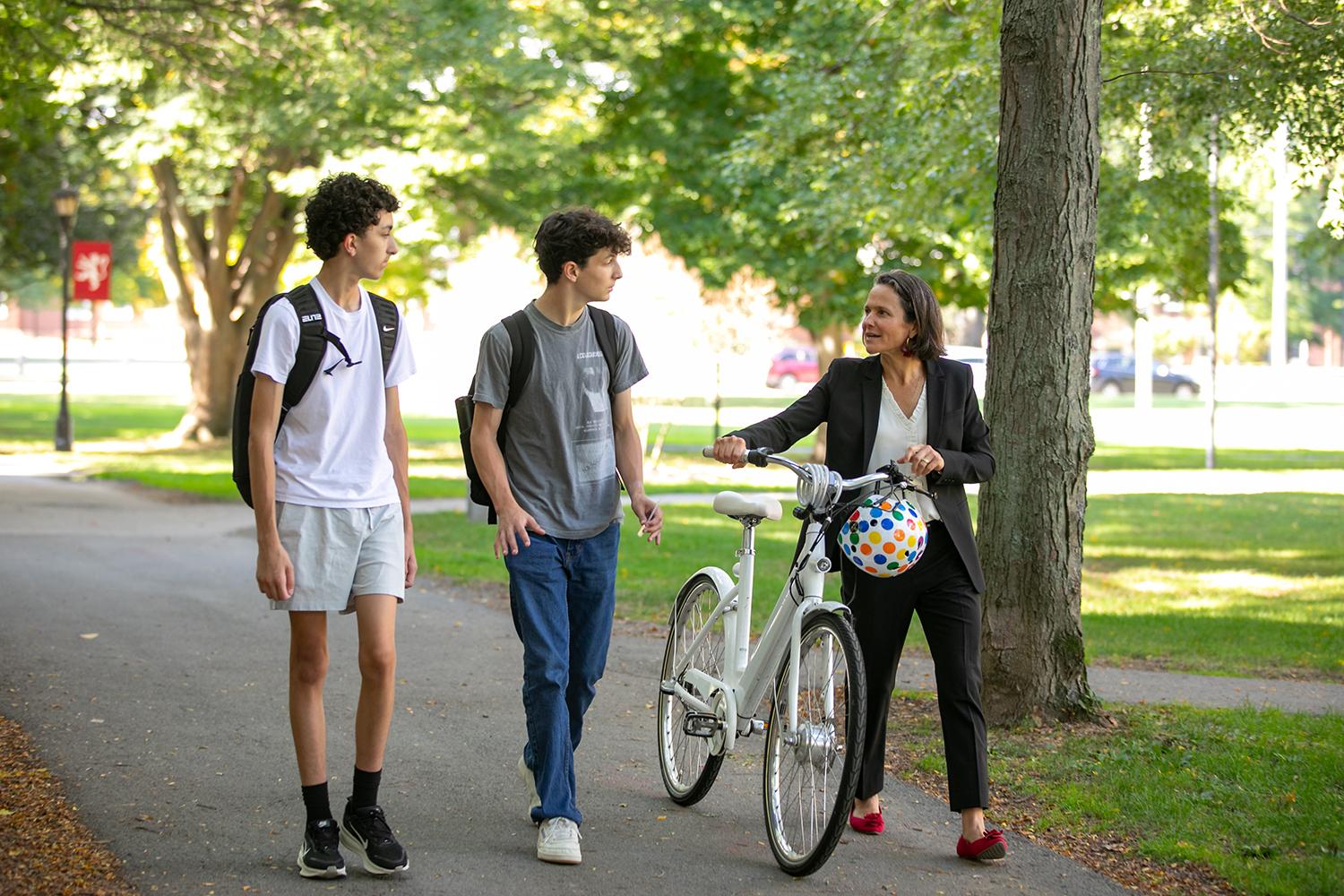
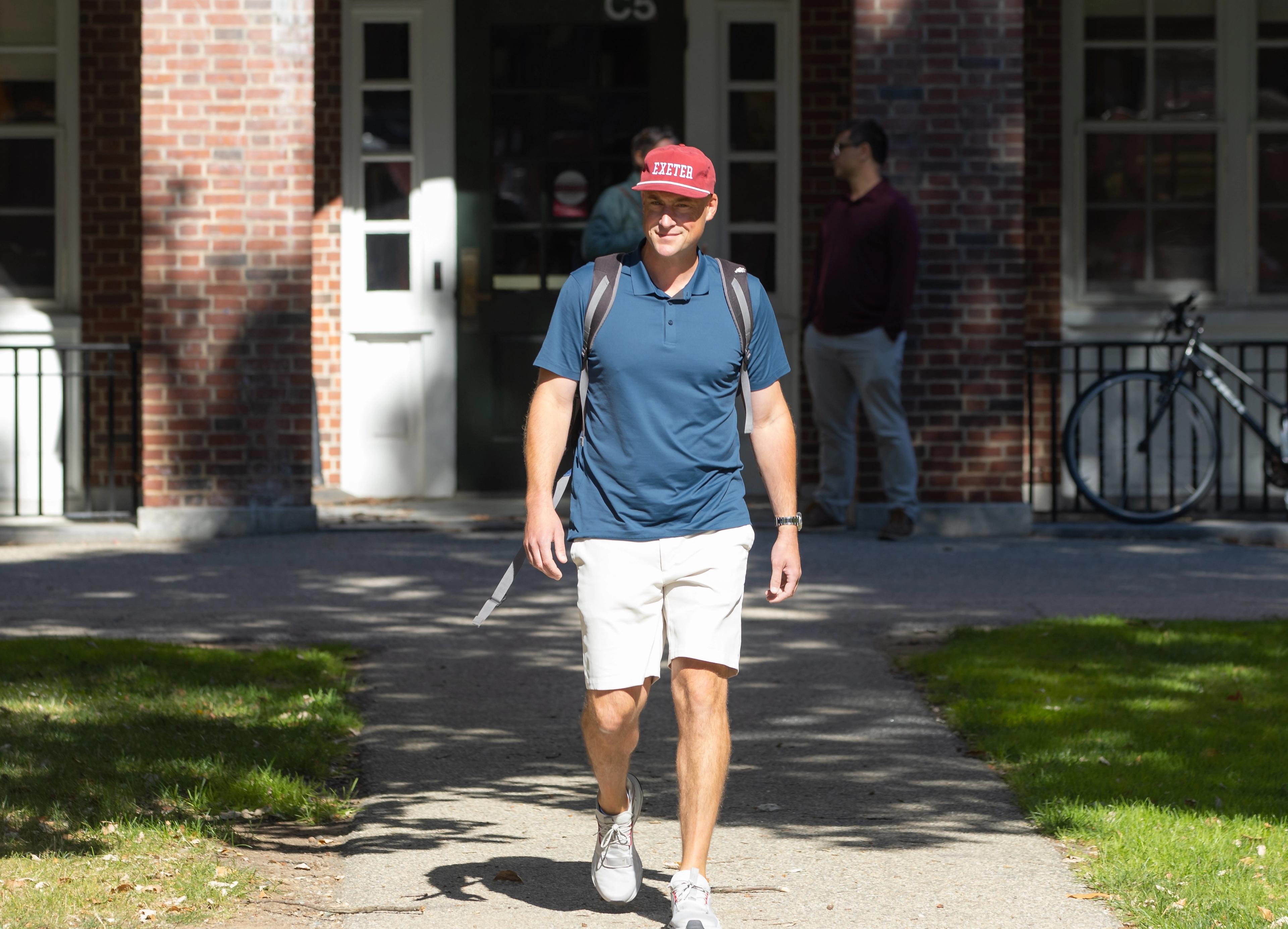
“Working with students gives her genuine energy and joy,” Page says of Elliott, walking the path.
Elliott has spent most of her life in spaces where the pursuit of excellence and the integrity of hard work are part of the fabric. She is both a product and a proponent of those worlds. She has come to appreciate the need to flex other muscles simultaneously. “As humans, whether you want to admit it or not, we love to play,” Elliott says.
She notes that at Stevenson School in California, where she previously taught, part of the mission is to lead a joyful life. “How do we create space for that?” Elliott says. “How do we create space for levity and recognize that we can still be very serious people? That we can think of our-selves as intellectuals and academics and be playful, and that that’s OK.”
Elliott says she wants graduates to describe Exeter as an inclusive and supportive community where they learned to stretch themselves, where they embraced challenges and where they explored their range. An Exeter where, she says, “They identified where their strengths were, but they were not afraid to tap into their vulnerabilities and areas of growth. And they felt like in those moments there were always supportive resources around them, and adults who were standing steady by them.”
A Shared Mission
In her Opening Assembly remarks, Elliott struck a respectful balance between honoring Exeter’s grand past and looking toward a hopeful future. The founding values in the Deed of Gift and the Academy’s overriding mission are as familiar as the alphabet to the dozens of faculty emeriti and three former principals in attendance. To a new principal, in a new home, they are a call to action.
“As your principal, I will work with you, day in and day out, like industrious bees in our shared hive, to carry out our mission,” she told the assembly.
Elliott vowed to prioritize students’ well-being and sense of belonging along with their academic excellence, and challenged the community to “prove — to each other and the world — that we can examine our assumptions, consider a wide range of perspectives and engage constructively with each other” in an era of division and polarization.
“I want our kids to to graduate from this place being like, ‘I have looked hard in the eyes, and I know I can do this.’ But I also want them to know that when hard comes, they don’t have to do it by themselves.”
When she spoke of the challenge AI presents to educators and learners alike, she promised the students that they would graduate with “sophisticated understandings of productive tools” but also with “the uniquely human qualities, values and strengths that will prepare you to positively engage in and constructively impact your next community.”
Palfrey says no one is better to help Exeter navigate the “thorny challenges” ahead. “I think about the way that she has been able to meet the moment so many times,” he says, “coming up with ideas and experiences that were just right for a challenging time.”
As Elliott finished her address, one observer in the front row appreciated the moment in a way only a mother could.
“After Opening Assembly, my mom said to me, ‘I just wish Mrs. Miralia could see you right now,’” Elliott says. “And I was like: ‘Mrs. Miralia? I haven’t thought of Mrs. Miralia in years.’ Mrs. Miralia was my sixth-grade teacher who had also been my older brother and my older sister’s sixth-grade teacher. And she apparently had a conversation with my parents because she was trying to fig-ure out what to do with me because I had a fair amount of energy.
“So they asked me to run the principal's office during lunch. As a sixth grader. Because I loved it, and I really wanted to keep it organized and keep the trains running, and I didn’t mind missing out on lunch. My mom said, ‘Mrs. Miralia would be so pleased, Jenny, that you figured out what to do with your energy.’”
Patrick Garrity is a deputy director of communications at Exeter and a contributing editor to The Exeter Bulletin.