In Service to the Rainforest
Conservation ecologist Nigel Pitman ’88 helps preserve one million acres of tropical forest each year
By Sarah Zobel
Fall 2026
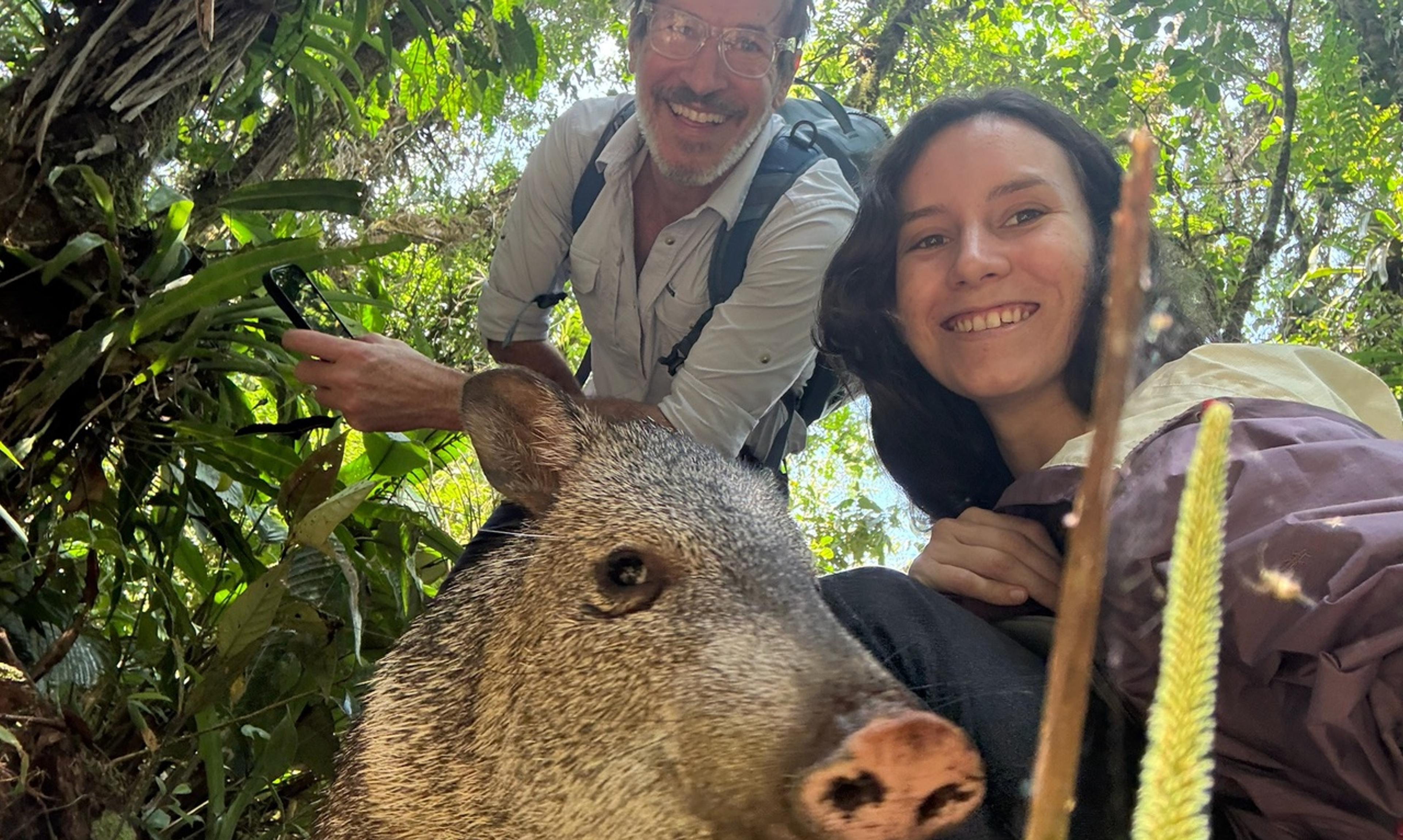
A recent commute to work for Nigel Pitman ’88 ended in a 52-hour boat ride. That was after traveling from his Chicago home to Manaus, a city in central Brazil. But Pitman is used to such treks. As a senior conservation ecologist at the Field Museum in Chicago, he visits the Andes Amazon multiple times a year.
“One of the joys of my work,” Pitman says, “is I get to see areas of the Amazon that are still incredibly well preserved.” Although his rapid inventories team is helping to fortify conservation efforts before the threats of mining, logging and wildfires arrive, he acknowledges that “it’s an emergency out there.” Deforestation can have devastating effects on local food production, plant and animal habitats, human rights and climate change.
The team focuses on vast, largely roadless expanses that local and federal governments and indigenous federations want to protect but lack information about. During the discovery period, Pitman and his colleagues visit for two to three weeks. The biologists head to the forest while the social scientists get to know the local communities; all groups are supported by cartographers and logistics experts. When the groups reconvene, together with local stakeholders, they compare findings to determine the best approach for that particular location.
“We’re looking for solutions that make sense for the people who’ve been protecting that land for generations,” Pitman says. “So we spend a lot of time exploring different scenarios with them and then making sure their voices are heard when we deliver our report to the minister or president.”
It’s methodical work that sometimes lasts decades, but the team has helped to preserve an average of one million acres each year. They are actively working on six areas in Guyana, Peru and Brazil that together eclipse New Hampshire in size.
“I’m an expert,” he adds, “but if you drop me into parts of the Amazon, I’m just as confused as anyone else.”
—Nigel Pitman '88
Pitman’s passion for ecology did not stem from his Exeter days. But he says the conservation work feels like a natural extension of one of the most important takeaways from Exeter: “There are so many ways to honor non sibi, and it has been my good fortune to work in the service of Amazonian forests, rivers and people.”
Pitman also recognizes that the skills he mastered in humanities classes, including the rigorous study of texts, clear writing and respectful and vigorous debate, were “quietly preparing” him for his career.
During a yearlong break after his freshman year at Princeton, Pitman worked at a park in Costa Rica, where he “fell in love with tropical forests” and learned to speak Spanish. (He’s now also fluent in Brazilian Portuguese.) He returned to Princeton to earn a bachelor’s degree in ecology and evolutionary biology with a specialty in Amazonian trees. His field calls for a sense of humor, he says, given that the Amazon is home to half a trillion trees and 16,000 species. “I’m an expert,” he adds, “but if you drop me into parts of the Amazon, I’m just as confused as anyone else.”
Pitman went on to receive his Ph.D. in botany and plant biology from Duke. He joined the Field Museum as a contractor in 2001, while living in South America. In 2013, he moved to Chicago for a one-year fellowship at the natural history museum and never left.
He says he enjoys the intellectual challenge of justifying the protection of land to government officials and others, but he is most content in the wilds of the rainforest — the more remote, the better.
“Instead of seeing lots of roads and agriculture and forest being cut down,” Pitman says, “what we get to see is forest to the horizon in every direction. That’s just such a joy.”