Exeter to the core
As a student, trustee and — for the last eight years — principal, Bill Rawson ’71 has lived and led by the Academy’s most fundamental values
By Sarah Pruitt '95
Spring 2026
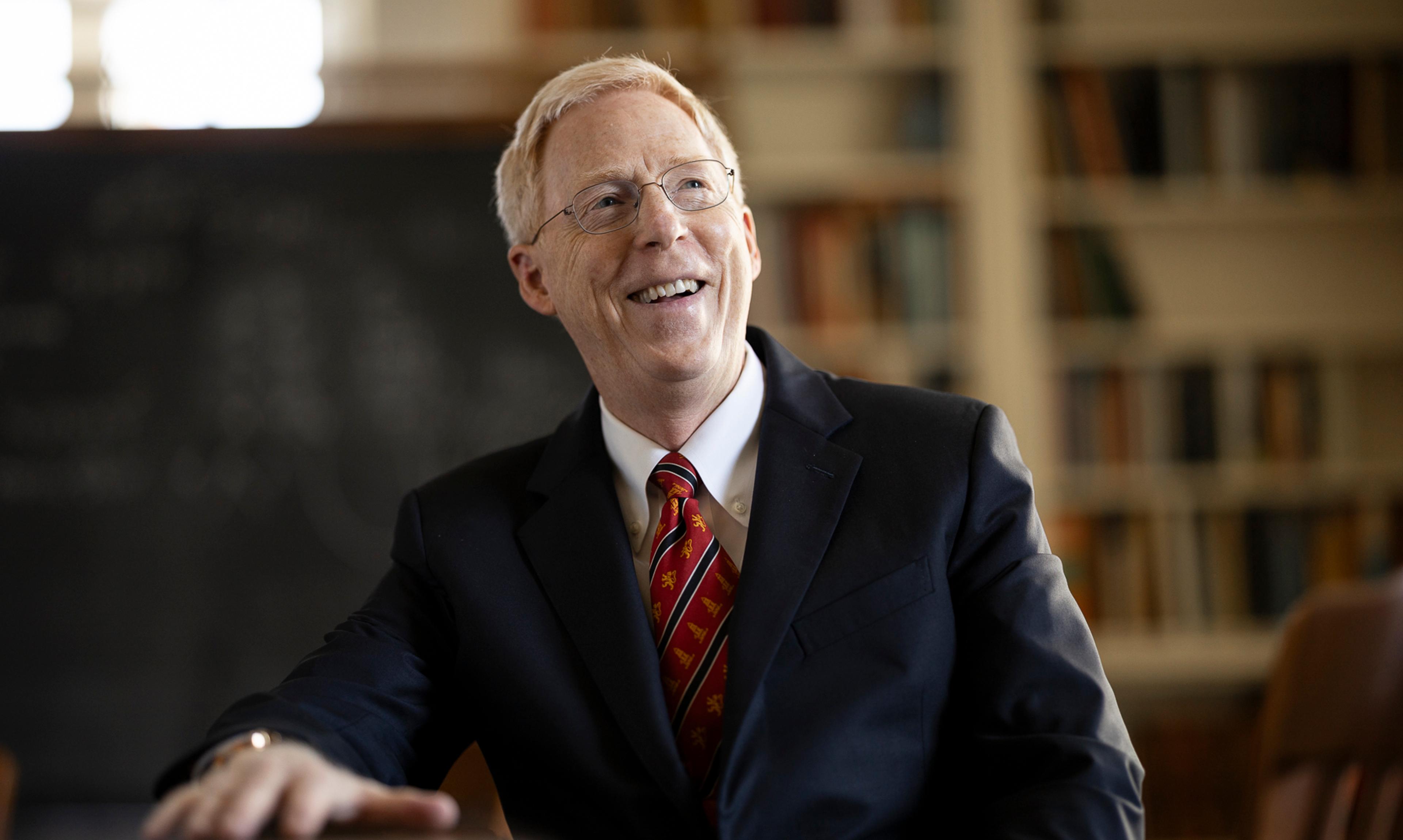
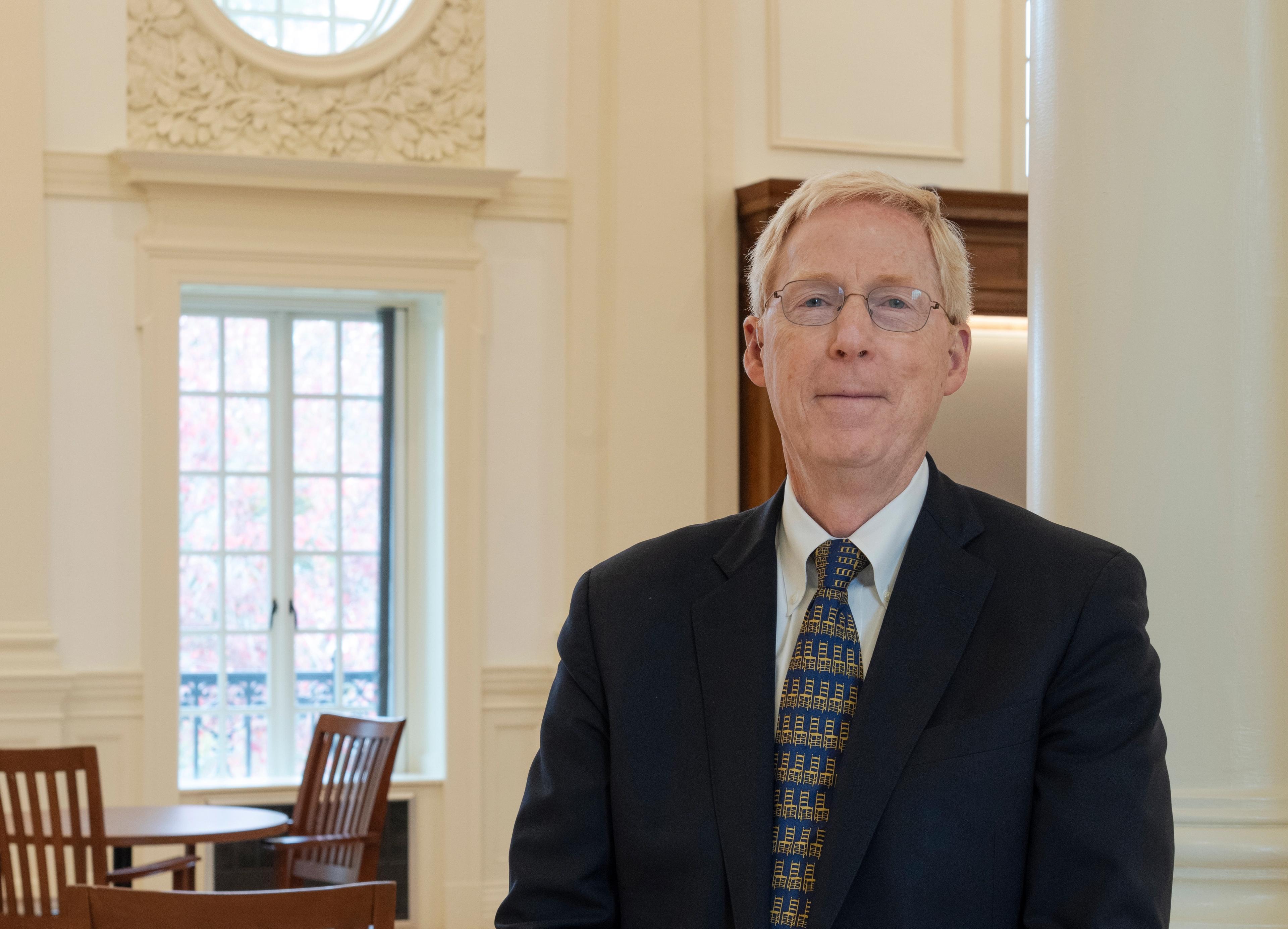
On move-in day in September 2018, Bill Rawson ’71; ’65, ’70 (Hon.); P’08 greeted arriving students and families while wearing a distinctive red Exeter T-shirt with “I’m new here, too!” emblazoned in white on its front.
Rawson wasn’t exactly a new face on campus. He had spent three years as a student at the Academy and worked as an admissions officer for two years after college, before embarking on an accomplished career practicing environmental law and litigation. He also served in a multitude of alumni volunteer roles, including Exeter Alumni Association director, class officer and longtime trustee. What the shirt’s message captured was his compassion and excitement about becoming the interim principal of the school he loved.
Addressing students and faculty in his first Opening Assembly, Rawson said he had wondered three things when he arrived as a new lower: Would I be able to do the work? Would I make friends? Did I really belong at Exeter? “Yes,” he told those gathered. “You can do the work. You will make lifelong friends. Absolutely, you belong here.”
Just six months later, the Trustees announced Rawson’s appointment as Exeter’s 16th principal.
Over the next eight years, he repeated those questions and their affirmative answers in every Opening Assembly. These words would become familiar to everyone on Exeter’s campus, and to many others in the global community of faculty, staff and alumni. To Rawson, these words are the foundation for his most important work as principal: fostering a strong sense of belonging in every student, faculty and staff member, and member of the alumni community.
“He distilled into these simple phrases a really important and complex idea about what the Academy is, and who the Academy is for, which is absolutely all of us,” Assistant Principal Eimer Page says.
Kobi Ajene ’27 recalls the impact of Rawson’s welcoming remarks at his first Opening Assembly. “That was a speech that I needed to hear,” he says. “It really reassured me that Exeter was the right place for me.”
Rawson, who will retire in June, built his leadership around a set of guiding principles grounded deeply in the Academy’s founding mission and core values. From the outset, he became an ever-present, ever-supportive figure for students in all their endeavors while building bonds with everyone in the Exeter community. Through significant challenges, Rawson led the school with a steady hand, a commitment to listening and learning, and a clear-eyed focus on what makes Exeter what it is, while remaining open to imagining what Exeter could be.
“While the buildings and the people at Exeter have changed over time, the founding values have not — they have informed the school for the 245 years of its history,” former trustee Tony Downer ’75 says. “Bill has been a scholar of and champion of those values in every decision that he made.”

When Lisa MacFarlane announced in early 2018 that she would be stepping down as Exeter’s 15th principal, the Trustees set out to find someone within the Academy community to serve as interim principal for two years while they conducted a search for her permanent replacement.
Rawson, who had recently retired as partner in the international law firm Latham & Watkins in Washington, D.C., remembers his reaction when faculty members who had known him as a trustee asked him to consider the interim role. “That really surprised me,” he says, “and made me think maybe this would be a way that I could serve the school.”
Downer, who led the Trustees during the search, can’t remember who first suggested Rawson as a potential candidate but calls it “a very interesting and out of-the-box thought” that also made a lot of sense. On one hand, Rawson lacked the academic background traditionally associated with Exeter’s “principal instructor.” On the other, Downer says, “He was somebody who knew the community at all sorts of levels and in many ways embodied the mission and values of the school.”
When the search committee reached out to community members for their views, consensus quickly built in Rawson’s favor. With the enthusiastic support of his wife, Mary, a history teacher and former Exeter Summer instructor, he decided to take the leap. “Exeter changed my life,” Rawson says. “When Exeter has called, I have never said no.”
Rawson is the fourth former Academy student to become principal, after Gideon Lane Soule (class of 1813), Harlan P. Amen (class of 1875) and William G. Saltonstall (class of 1924). “Bill shared the students’ experience, but his law career gave him real-world perspectives that he could use in his leadership position with faculty and fellow administrators,” former trustee Rob Shapiro ’68 says.
“Looking back at past principals, including myself, I think everyone has had their job to do, and those have been different jobs,” says Kendra Stearns O’Donnell, who led Exeter from 198797. “Bill really took on the work of his time with integrity, imagination and real sensitivity to both the history of the Academy and the needs of the people and programs in the present.”
Director of Institutional Advancement Morgan Dudley ’77 says Rawson brought “transparency, integrity and a sense of calm” as the school was addressing challenges, including fallout from the handling of past sexual misconduct on campus. “He dedicated himself to repairing relationships, making hard decisions, and doing all that was in the best interest of the school,” Dudley recalls.
With the support of faculty, staff and alumni, the Trustees realized that they had found Exeter’s next principal. “It was clear what the community wanted,” Downer says.
After Rawson’s appointment, his classmate (and former lacrosse teammate) Roberto Garcia ’71 wrote to offer his congratulations and well wishes. “He was the right person at the right time and the right place,” Garcia says.
Rawson’s tenure as principal has coincided with turbulent and challenging times for all school leaders, including the effect of unsettling global events like the wars in the Middle East and the bitter partisan divides and polarizing nature of the U.S. political landscape. In both his messages to the community and his actions, Rawson has consistently responded with an emphasis on the values that are vital to the Harkness philosophy: listening to and learning from one another, being open to different ideas and perspectives, and nurturing a supportive environment for all students and adults on campus.
During the COVID-19 pandemic, with students scattered far and wide, faculty members forced to adopt the Harkness pedagogy for remote learning, and concern for the health and safety of all community members, Rawson relied even more heavily on this human-centered, mission-driven, inclusive approach to leadership.
“‘Exeter’ is not bounded by its geography,” he said to an empty Assembly Hall during the first virtual assembly in May 2020. “‘Exeter’ lives within each of us and forms around us, no matter the distance between us.”
Director of Equity and Inclusion Stephanie Bramlett recalls the challenge of continuing to provide all students with equitable support, given the vast differences in their off-campus circumstances and experiences. “Suddenly we had to think about — how do we continue to be a safe place for them and also give them what they need so they can be successful?” she says. “Bill was a fantastic partner in those efforts.”
A modern mission statement
“Unite goodness and knowledge and inspire youth from every quarter to lead purposeful lives.”
At the end of his first year as principal, Rawson worked with a small group of faculty and trustees to produce a modern expression of the Academy’s mission statement and an articulation of five core values: knowledge and goodness, academic excellence, youth from every quarter, youth is the important period and non sibi.
Every key word in the updated mission statement, which Rawson introduced at Opening Assembly in 2020, can be traced to the Deed of Gift signed by John and Elizabeth Phillips in 1781.
“I read quite a number of histories of the Academy when I arrived,” Rawson says, “and I learned a lot about the founding and history of the school, especially the democratic spirit that was there from the very beginning.”
He says he looked to Harlan P. Amen, William G. Saltonstall and Kendra Stearns O’Donnell, the school’s first female principal, among others, as examples of leaders who remained true to Exeter’s founding spirit while confronting difficult challenges and moving the school forward.
“We are blessed with a Deed of Gift that provides a foundation and articulates a compelling mission,” Rawson says, “but we have also always been open to evolving and living into our founders’ words in ways that make us not just a stronger school, but more true to our values and our mission.”
President of the Trustees Kristyn Van Ostern ’96 sees Rawson as an effective messenger for this philosophy. “Almost every time he spoke,” she says, “Bill reminded everyone that change is part of what makes us great as an institution.”
Rawson’s consideration extended not only to students and faculty, but also to all of Exeter’s employees. “He put a lot of work and thought into how do we make sure that we are keeping all our people safe and whole?” says Page, who worked alongside the principal to help manage the school’s pandemic response. “How do we make sure that we’re giving people meaningful work?”
Students began returning to campus for fall term in 2020, but COVID-19 protocols and restrictions remained in place months longer. With his unwavering focus on fostering community on campus, Rawson did his best to ensure that the most important aspects of the Exeter experience endured. He also made efforts to maintain a personal connection with students, including by doing regular dorm duty in Wentworth Hall.
Zara Ahmed ’22 remembers eating outside on Soule Hill with friends in the spring of 2021, when dining was still limited to grab-and-go options. Rawson walked around and spoke with her and other students. “He was making sure that his presence was known, and he was checking in on us,” Ahmed says. “It felt like even though things were different, we were still all in it together.”

Perhaps no single accomplishment represents Rawson’s legacy better than the Academy’s commitment to admit students regardless of their families’ ability to pay tuition. Rawson speaks often of his Exeter experience as a recipient of financial aid, and the jobs he worked on campus — including waiting on faculty tables and washing dishes in the dining hall — to supplement his scholarship. For him, need-blind admissions and meeting the full demonstrated need of every student are fundamental to living up to John and Elizabeth Phillips’ intention to establish the Academy as a free school, and Exeter’s longstanding tradition of accessibility to students of all backgrounds and financial circumstances.
While Exeter donors had committed more than $90 million in new endowment funds for financial aid from 201921, further support was needed to sustain a need-blind admissions policy through the school’s 250th anniversary in 2031. Kristyn Van Ostern ’96, the current president of the Trustees, recalls how Rawson persuaded them to announce need-blind admissions even before full funding had been secured. “He argued that making that bold, audacious commitment would attract more support — and he was absolutely right,” she says.
After unanimously voting to adopt need-blind admissions in October 2021, the Trustees rose to their feet and applauded, acknowledging the moment; the generosity of Exeter’s alumni, parents and friends; and the principal’s leadership. “Bringing this to the Trustees for a vote required the confidence that we would be able, forevermore, to continue to secure support for future students with financial need,” Dudley says. “It was a courageous and significant decision.”
“Principal Rawson is going to be there. He’s going to invite you into his home.”
Without the cost, structure or travel associated with a capital campaign, the Academy has raised more than $400 million during Rawson’s tenure, including nearly $150 million to sustain the needblind commitment. Dudley credits this in no small part to the clarity of the Academy’s mission and priorities, the time Rawson has devoted to communicating those priorities to alumni and families, and the confidence these audiences have in Rawson’s leadership.
Rawson has also advanced ambitious new construction projects and campus improvements, some supported by fundraising and others made possible through the Trustees’ careful stewardship of the school’s resources. All have been aimed at enhancing the student and faculty experience for present and future Exonians.
Building on the strategic vision set forth in a comprehensive Campus Master Plan completed in January 2021, the Academy opened its first new dormitory in more than 50 years in the fall of 2022. Adjacent to Dow House and Guptill House, the new dorm anchors a vibrant campus neighborhood on Front Street housing 60 girls as well as four Harkness classrooms and offices for the Health and Human Development Department. A year later, a neighborhood with 12 new faculty residences opened on High Street near Grainger Observatory, part of efforts to bolster community among adults on campus as well as students.
In late 2024, the Hahn Center, with its expansive main dining hall and stateof-the-art kitchen, opened on the site of Wetherell Dining Hall, instantly becoming a bustling community hub on the north side of campus.
Perhaps most personally for Rawson, the former Davis Library, for so long a relatively forgotten space, has been revitalized during his tenure. “That was my library,” he says. “The building was something we just walked by for a long time, and to see it brought back to life is quite meaningful.” Now home to the Classical Languages Department, the stately Davis Hall also houses a large reading room on the second floor. It is named for Rawson’s wife, Mary Homeier Rawson, who died just before he became principal. “She was such an important figure in his life,” Page says, “and her pathway through education also influenced him.”
Rawson has helped to shepherd a comprehensive renovation of the central academic building on campus — the Academy Building, including an overhaul and expansion of Assembly Hall and the construction of a new Design Lab, which is scheduled for completion in the 2026–27 school year. Like all the recent construction and renovations on campus, the building’s renewal is designed to help meet the reduced carbon emission goals and other objectives in Exeter’s first sustainability and climate action plan, which Rawson announced in 2023.
In his last year, Rawson has advanced two final capital projects at Love Gymnasium: an extension of the Downer Fitness Center and the construction of a four-lane auxiliary swimming pool with a shallow end. The new pool will provide better swimming opportunities and safer instruction for faculty and staff families year-round and enable the school to once again host New England swimming championships. Both projects are fully funded and are expected to be completed by 2027.

At the heart of all these initiatives are Rawson’s trademark ethos of “building on strength” and his dedication to ensuring that all students and adults on campus have rich and meaningful experiences — and that they truly feel they belong at Exeter.
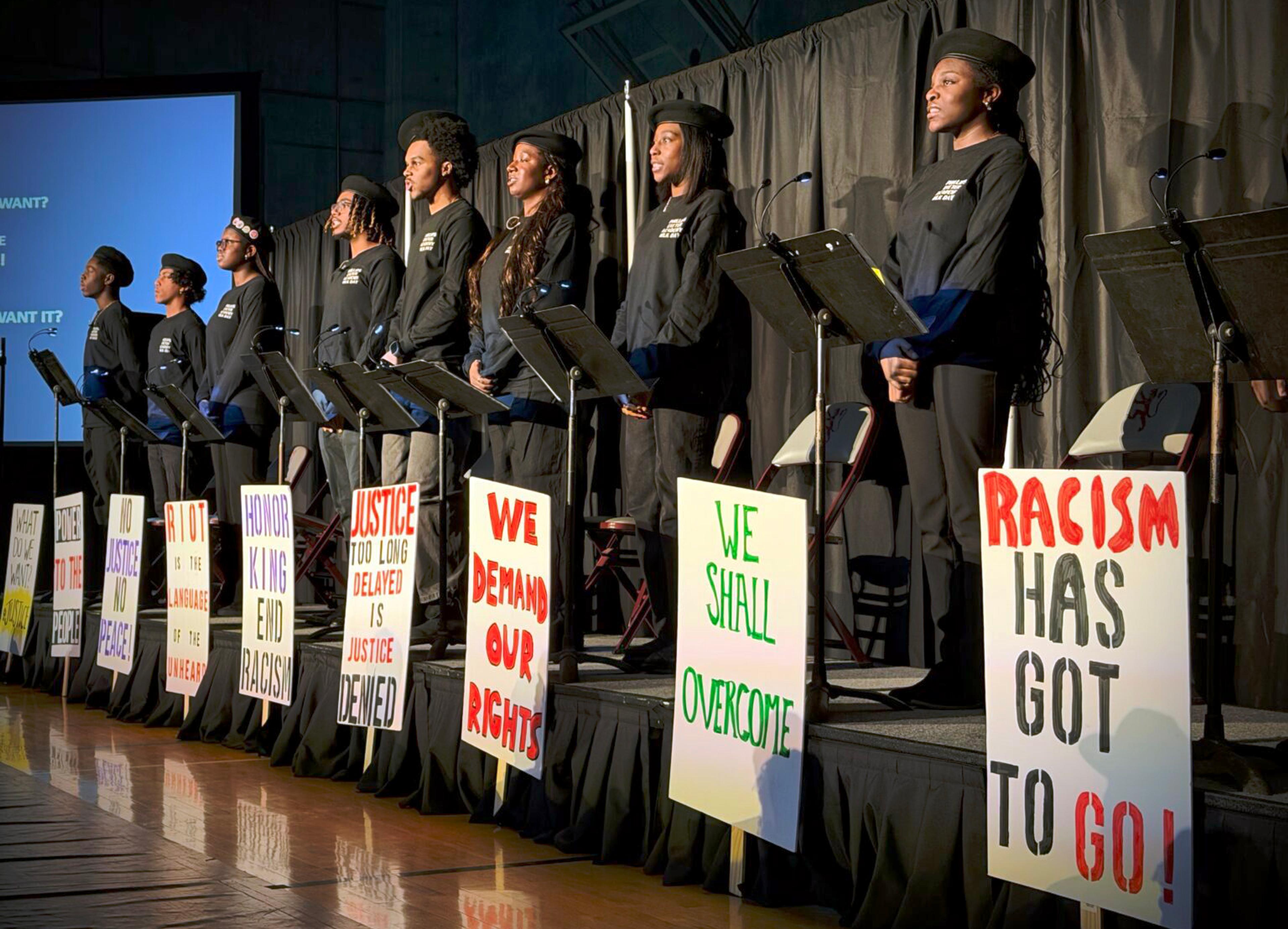
This dedication is evident in the ways the school community celebrates the diverse traditions of its members — including Passover, Lunar New Year, Holi, Ramadan and Christian holidays. Rawson hosts many events at his home, Saltonstall House: frequent dinners with assembly speakers; meals with wide-ranging groups including the Democratic and Republican clubs and Black Students of Excellence; and an annual hot wings eating contest. He has also tried to foster a sense of belonging among Exeter’s alumni through events like the 55th anniversary of the AfroLatinx Exonian Society in 2024.
Rawson’s accomplishments aside, students, faculty, staff and alumni point to his thoughtful, warm and supportive presence as perhaps the most outstanding feature of his time as principal. “Our students know that the principal is going to show up to their events,” Bramlett says. “Concerts, theater, athletic competitions, Jummah prayer, Shabbat — Principal Rawson is going to be there. He’s going to invite you into his home. He’s going to know your name.”
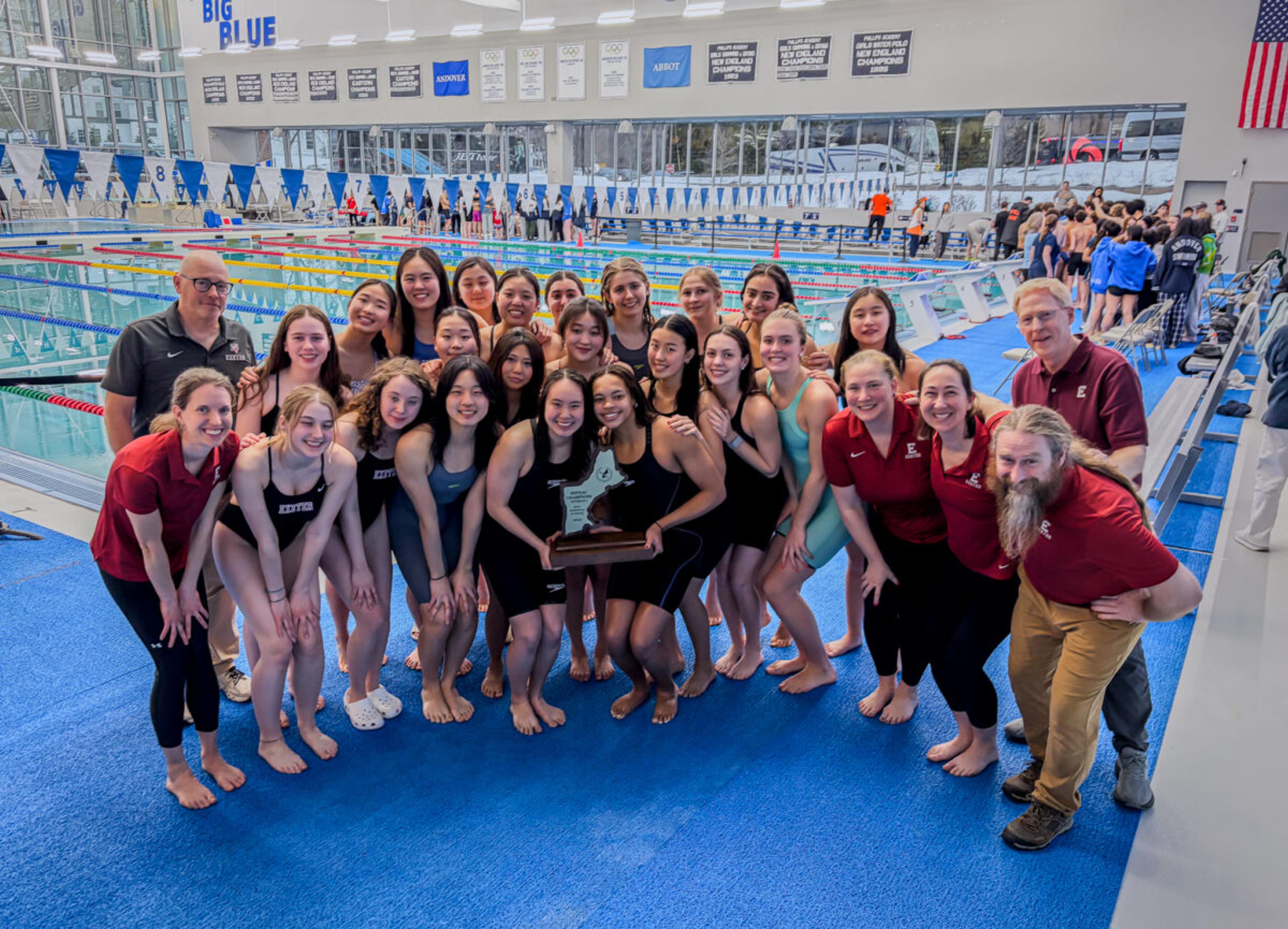
In one memorable instance, Rawson watched Exeter’s girls varsity swimming team win their second straight New England title at Andover in March 2024. Jinmin Lee ’26 recalls being in the stands when the victorious swimmers began calling for the principal to join them in the pool. “We never thought he’d actually do it,” Lee says.
But amid the students’ frenzied cheers, a fully clothed Rawson executed a front flip into the pool. After borrowing dry clothes from an Exeter coach, he promptly hopped in his car and headed to Clark University in Worcester, Massachusetts, to watch the boys basketball team capture its fifth NEPSAC Class A title.
Director of Athletics Jason Baseden says that day was just one outstanding example of Rawson’s showing up to support Exeter students. “It’s not often that you get a head of school who finds the time to come to games, and even practices,” Baseden says. “He’s been a special presence in person at many memorable games and events.”
Rawson has supported students in the arts equally by regularly attending performances at The David E. and Stacey L. Goel Center for Theater and Dance and the Forrestal-Bowld Music Center. “I think if he’s missed a show, it’s maybe one or two in his time here,” Instructor in Theater and Dance Lauren Josef says. During one rehearsal he attended, she adds, Rawson even took on the role of a Munchkin to help students block out a scene in The Wizard of Oz. “He was out of his element,” Josef says, “ but he went with it.”
As Rawson’s eight-year tenure draws to a close, he feels he is leaving the Academy in a strong position, though — as always — important work lies ahead for the school to continue to grow and change along with its students and the world.
“I feel fortunate to have been part of this community and to have been able to serve the school in this way,” Rawson says. “You never really understand how meaningful it is going to be until you’re here and you start doing the work, making the friendships, and feeling the sense of purpose that comes with being part of this community. It is always more than you could have imagined.”