Supply and Demand
The puzzles and potential of studying economics at Exeter
By Sarah Pruitt '95
Summer 2025
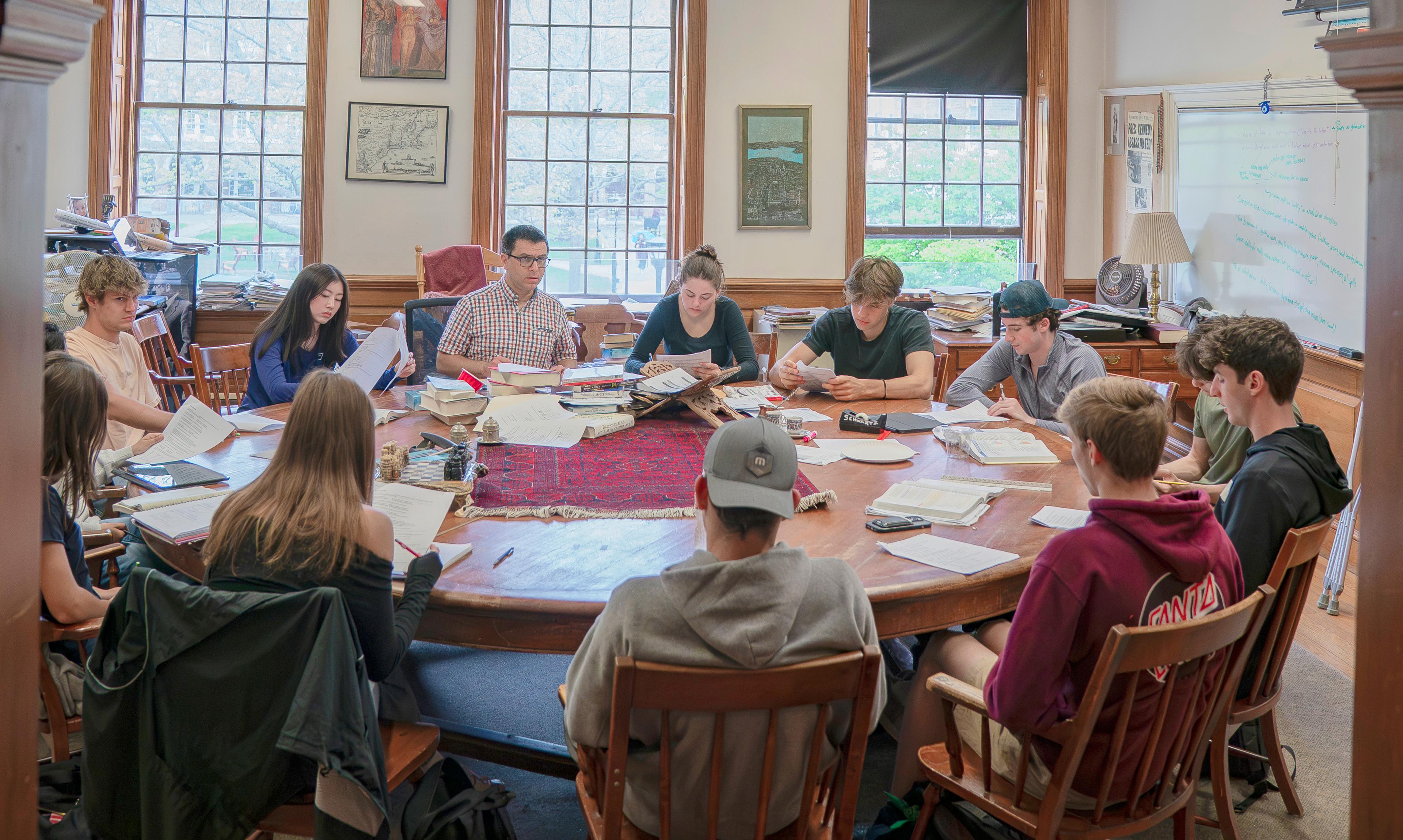
Twelve students enrolled in ECO520: Microeconomic Theory and Policy formed teams in May to debate the pros and cons of globalization. The next time the class met, the students asked History Instructor Aykut Kilinc which team had won the debate. Instead of answering, Kilinc presented them with two alternatives:
He could announce the winning team, and the members of that team would receive a 10% grade increase on the next test, while the losers would be docked 7%.
Both teams could forgo knowing the results of the debate and agree to have 2% deducted from their next test scores.
“Think like an economist,” Kilinc told the students. “Which option would you choose?”
To decide, the students confronted a version of the prisoner’s dilemma, a metaphor for situations in which individuals (or nations or businesses) acting in their own interest can sometimes lead to worse outcomes for everyone.
In the classic example, two suspects in a crime, held in separate cells, are offered a choice between confessing or staying silent. If both confess, they each will receive a moderate sentence. If both stay silent, they each will receive a lighter sentence. But if only one confesses, the confessor will receive a light sentence — or even go free — and the silent one will receive a harsh sentence.
Each suspect has a strong incentive to confess, given the possibility that the other will do the same. Therein lies the paradox, as both suspects could achieve the best outcome by staying silent.
Students in Kilinc’s class, like all who enroll in the five economics-focused courses Exeter offers, explore how financial markets work, including key concepts like scarcity, supply and demand, and opportunity cost. But as the prisoner’s dilemma illustrates, the core of economics is the study of human behavior: how people and institutions manage and use their money, time, labor and other resources. By studying economics, students gain financial literacy, a better understanding of their spending habits, and training in the analytical and problem-solving skills that will serve them well in nearly every professional field, as well as in daily life.
Perhaps that’s why economics consistently ranks high among the nation’s top college majors, including The Princeton Review’s recent list of the 10 best majors in terms of job prospects and alumni sal-aries, and USA Today’s ranking of majors that offer the best return on investment.
With the increasing popularity of economics in colleges has come a corresponding rise in demand for economics and personal finance education in high schools. Economics has long been viewed as applicable to many professional fields and pursuits, including finance, public policy, engineering and climate science.
Exeter, like many of its peer schools, has met this growing demand by greatly expanding its economics programming over the past several decades. Today, Exonians seeking exposure to economics can find it through a robust slate of popular classes, a highly competitive student-led economics club and two international trips focused on business and entrepreneurship.
THE ORIGINS OF EXETER’S CURRENT economics offerings date to the late 1970s, when History Instructor E. Arthur Gilcreast took over an existing business course and helped develop an economics-focused history course, HIS45E: Understanding the American Economy. The two courses aimed to help students understand how the U.S. economy works and the origins and workings of the free enterprise system.
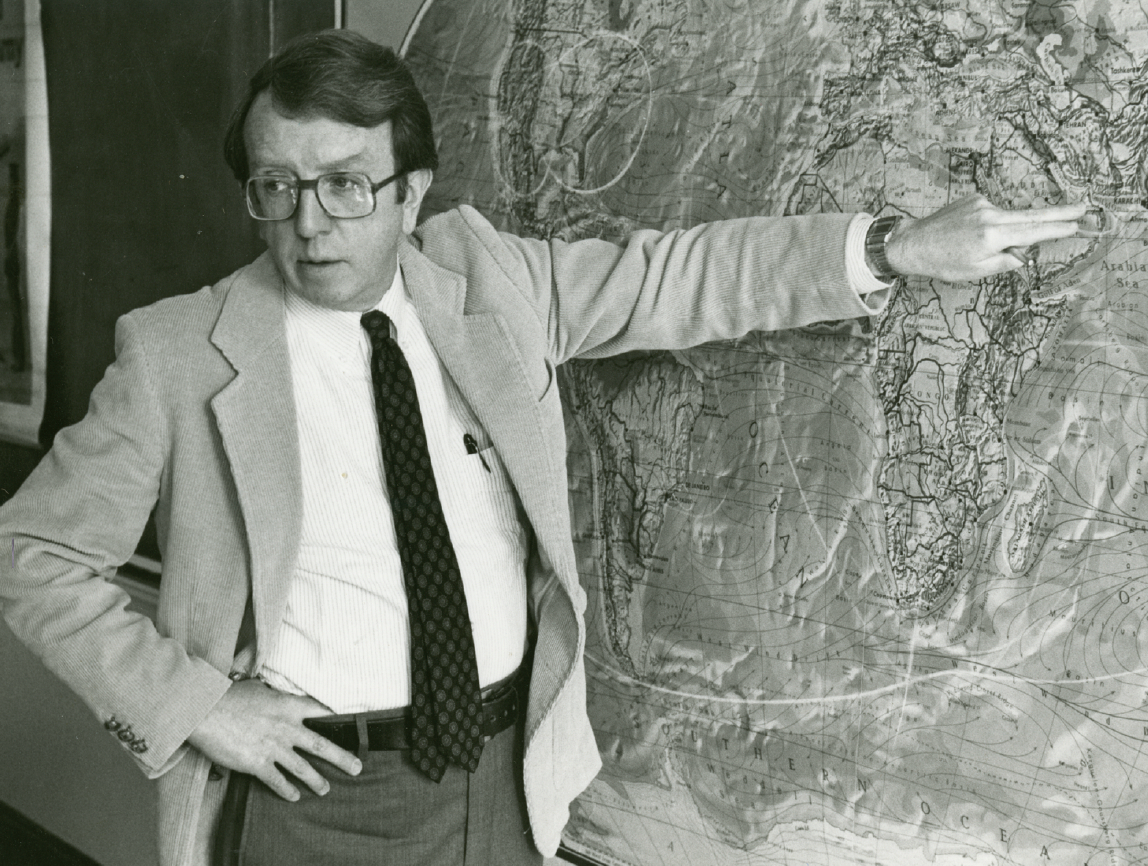
According to a 1980 article in The Exonian, the business course had been offered at Exeter since the 1830s. It was taught by one of the Academy’s finan-cial officers, usually the treasurer, before Gilcreast took over. “Many people in this school are going to be businessmen, and it’s important they learn what it’s all about now,” Gilcreast told the student paper.
In 1981, as Exeter celebrated its bicentennial, Gilcreast received the newly created Arthur A. Seeligson, Class of 1913, Professorship in Business, Economics and History. Two years later, Principal Stephen Kurtz formed a committee (headed by Gilcreast) to undertake a comprehensive review and overhaul of the Academy’s curriculum. The “New Curriculum,” fully implemented for the 1986–87 school year, included a switch to a trimester calendar and a robust new slate of senior-level courses.
Among those were the first two courses offered under the heading of Economics in the Courses of Instruction catalog — Contemporary Economic Issues in the United States and Government and Business in the United States — and a new economics-focused history course, now HIS506: Capitalism and Its Critics. In a similar spirit, the Religion Department introduced what is now REL460: Ethics of the Marketplace that year.
“By studying economics, students gain…skills that will serve them well in nearly every professional field as well as in daily life.”
The economics curriculum at Exeter has since been honed and expanded. History Instructor Meg Foley, who assumed the Seeligson Professorship in 2008, helped develop her department’s second economics-focused course, now HIS556: Why Are Poor Nations Poor? Former History Instructor Giorgio Secondi helped refine the existing economics courses and introduced a course in microeconomics.
ECO520: Microeconomic Theory and Policy is now one of Exeter’s three dedicated economics courses, along with ECO510: Macroeconomic Issues in the United States and ECO502: Principles of Economics and Business, an overview course that covers principles of both macroeconomics and microeconomics.
Although they meet no department requirements for graduation, Exeter’s economics courses are among the most popular electives in the course catalog, with enrollment often filling five or more sections per term when they are offered. “I love that because they’re not required, the students are in the course because they really want to learn about these topics,” says Foley, who has taught all five economics-focused courses.
Kilinc, the current Seeligson professor, attributes some of the popularity of the economics courses to the ups and downs of the U.S. economy in recent decades, including the 2008 financial crisis. “I think students want to understand how the marketplace works, how money works and, in so many ways, even how people work,” Kilinc says.
Foley and Kilinc agree that students also see economics as a great way to combine mathematical and analytical skills with an interest in social science, not to mention as a practical choice in terms of college studies and career aspirations. “Even if people specialize in different areas or different fields, they are still required to understand business and economics,” Kilinc says.
WHAT EVAN SOLTAS ’12 SAYS HE remembers very clearly from economics classes at Exeter is “a sense that you were being approached as an equal in the conversation. That you were all there to think through a challenge together, and that these questions were hard, important, interesting and real.”
By the time Soltas came to Exeter as a new lower in 2009, he had developed a keen interest in studying economics. At his former high school, he was involved in the Fed Challenge, a national compe-tition for high school students run by the Federal Reserve Bank of New York.
“It really felt at the time, and still does to me, that economic challenges are really important,” Soltas says. “This is where it feels like research and evidence and discussion are actually valuable — that they’re going to have some contribution to social progress.”
At the Academy, Soltas studied macroeconomics and microeconomics with Secondi, who became an influential figure in his academic life. As a senior, Soltas started the blog “economics & thought,” in which he shared daily commentaries on various topics in economics. After the blog caught the attention of Slate and other national news organizations, as well as prominent economists, Soltas became a reg-ular contributor to Bloomberg News and The Washington Post.
“In retrospect, [the blog] quite quickly took off into something that I was completely unprepared for,” Soltas says. “In many ways, I’ve been riding that wave ever since.”
Soltas majored in economics at Princeton and led the university’s Fed Challenge team. After graduation, he spent two years at Oxford on a Rhodes Scholarship, earning his M.Phil. in economics. In 2024, Soltas completed his Ph.D. at MIT, then spent a year as a post-doctoral fellow at Microsoft Research in New York City before returning to Princeton as an assistant professor of economics and public affairs.
He traces his interest in his primary field of study — urban economics and policy, particularly housing markets — to his years growing up in New York City, as well as his time at Exeter. For his U.S. history term paper (or “333”), Soltas wrote about New York City’s urban decline from the 1950s to the 1970s.
“I’ve always been fascinated by cities,” he says. “There’s great data to study, and the economics are complicated and interesting. Cities make concrete so many theoretical roles for the govern-ment, confronting us with its real-world failures and successes and challenging us to learn from them.”
UNLIKE SOLTAS, HOAI-LUU NGUYEN ’03 came to Exeter with no affinity for economics. That changed when she took Foley’s Capitalism and Its Critics class. Based on that history course and the two economics courses she took at Exeter, Nguyen decided to major in economics at MIT, where she earned her B.S. and Ph.D. in the subject.
Nguyen says she was drawn to eco-nomics as “a study of people, and of the institutions that people create,” an idea she absorbed through Harkness discus-sions. This broad view of the discipline, she says, includes everything from solving huge global challenges to investigating basic questions about human behavior.
“That’s not always a view of economics that comes across very strongly in undergrad econ courses like Micro 101 or something,” Nguyen says. “Those courses necessarily start with fundamentals of economic theory, like supply-demand models and models of trade.”
Formerly a professor at the Haas School of Business at the University of California, Berkeley, Nguyen is the founder of econimate, a YouTube chan-nel aimed at making economics research accessible and engaging. For the channel, Nguyen creates and narrates animated summaries of the papers being written and published by top economists on topics like the consequences of losing a low-wage job or the cost of political corruption, to name two recent examples.
“These papers are not written to be consumed outside of academic circles,” Nguyen says. “Yet precisely because economics asks so many questions that have direct impact on people’s lives, I think what we learn from this research can be of broader interest than just to other professors.”
Students Leverage Business Skills in Startup-Friendly Berlin
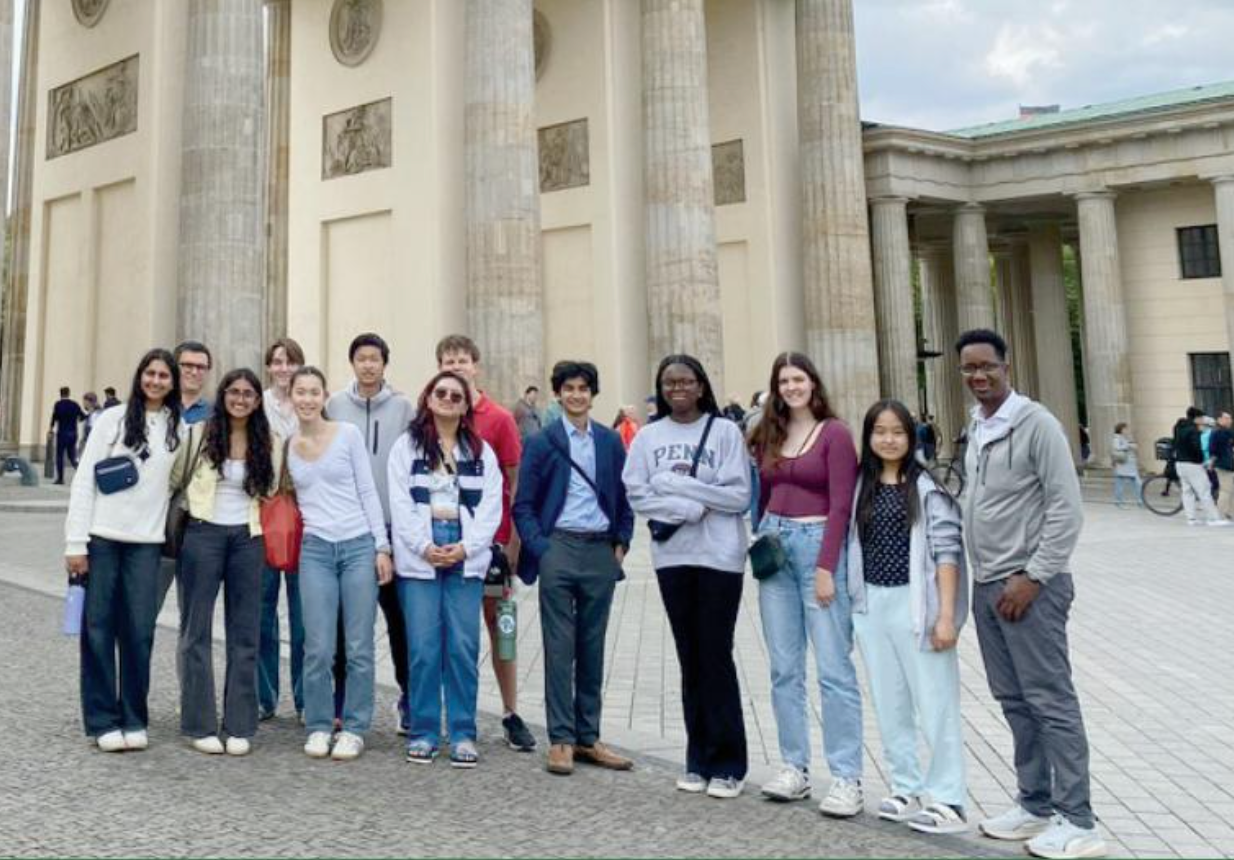
In June, a group of Exeter students and faculty headed to Berlin — a vibrant, culturally diverse city that has become a hub for startup businesses in Europe — to study supply and demand, equilibrium, opportunity cost and other key economic concepts.
The Berlin program, started in 2022, is one of two international trips offered through Exeter’s Global Initiatives curriculum that is focused on business and entrepreneurship. Students have also traveled to Singapore.
Beginning this summer, students in Berlin are earning course credit during the three-week intensive version of ECO502: Principles of Economics and Business. The course explores the same principles and macroeconomic and microeconomic questions as the on-campus version but with some focus on the German economy. In addition, students also take German language classes and meet with local entrepreneurs to talk about sustainable business practices.
For Ally Rubin ’26, the trip was an exciting blend of studying business and economics and gaining on-the-ground experience, such as touring the BMW factory and talking with members of the German Parliament to learn more about the country’s economic and political structures. “This trip has furthered my passion for economics and allowed me to gain a new perspective about Germany, and the culture and history that makes it what it is today,” Rubin says.
Nguyen credits Foley’s class and the others she took at Exeter with helping her choose a field of study before she enrolled in college — earlier than many of her peers. Viewed through the broad lens she embraced at Exeter, she sees economics as appealing to a wide range of students with differing career aspirations.
“If you’re interested in the climate crisis, or inequality, or poverty, or how the govern-ment works, or how public policy gets made … these are all questions that are studied in fields of economics,” Nguyen says.
BEYOND THE CLASSROOM, CURRENT Exonians can pursue an interest in eco-nomics through the Exeter Economics Association, a thriving student club, as well as Global Initiatives summer trips to Berlin and Singapore, both bustling hubs of business and entrepreneurship. (See “Entrepreneurship Abroad,” p. 49]
Dhruv Nagarajan ’25, the most recent co-head of the Exeter Economics Association, was first drawn to economics while watching financial news during the pandemic lockdown. “I’ve always been big into puzzles,” he says, “and I like to view the economy as one big puzzle, where there’s a lot of cause and effect.”
For Nagarajan, the club’s twice-weekly meetings strike a balance. Monday’s curriculum sessions are dedicated to serious study. The Sunday gatherings over din-ner in the Seabrooke Room at Elm Street Dining Hall are more casual.
“We have this competitive aspect, and there’s definitely demand for that at a school like Exeter,” he says. “But we also have the more low-key, chill dinner discussions that I and a lot of the competitors also regularly attend, to remind us that it’s not all just about the competitions.”
Students from the EEA regularly enter prestigious competitions like the Northwestern Economics Tournament, the Harvard Pre-Collegiate Economics Challenge and the National Economics Challenge, run by the Council for Economic Education. To prepare for competitions, club members use a 60-plus-page text-book they have created over the past few years. Nagarajan says the text covers both AP material and more advanced theory in macroeconomics and microeconomics.
At the most recent NEC in Atlanta in May, Exeter teams placed second in the Adam Smith Division, for returning, advanced and honors economics students, and the David Ricardo Division, which includes first-time competitors who have taken no more than one economics course.
Nagarajan recalls another proud moment at the Northwestern tournament in 2024, when Exeter’s A team defeated Exeter’s B team in the final quiz bowl round to capture first place. “When I was sitting there, it felt like it was no different from our Monday morning meetings in the Forum at EPAC,” he says. “Only this time it was onstage at the Northwestern competition.”
In addition to his extracurricular eco-nomics activities, Nagarajan took Exeter’s macroeconomics course, as well as the two economics-focused history courses. “I really enjoyed the balance of integrat-ing macro with the Harkness method,” Nagarajan says. He gained new perspective discussing the work of influential political economists throughout history — such as Smith, Ricardo, John Maynard Keynes and Karl Marx — around the table with his classmates in Capitalism and Its Critics.
“I knew from studying for these competitions which thinkers had writ-ten which texts and postulated which theories,” Nagarajan says. “But I hadn’t yet fully unpacked the actual writing and what they were talking about, to the extent that I did in that course.”
Exeter's Nobel-Winning Economists
Lloyd Shapley ’40 received the 2012 Nobel Memorial Prize in Economic Sciences for his contributions to the field of mathematical economics and game theory.
Paul Romer ’73 was a co-recipient of the 2018 Nobel Memorial Prize in Economic Sciences for demonstrating how knowledge and innovation can drive economic growth.
IN KILINC’S CLASSROOM, HIS microeconomics students had to reflect on the problem he had posed before mov-ing on to discussing the rise in counterfeit goods in the global marketplace, the effects of technology on the price of chicken and other topics. Did they demand the results of the globalization debate or choose to forgo a verdict in favor of attaining the best test results for the entire group?
“Let’s take a vote,” Kilinc said. “Do you want to know who the winner is?”
A few hands went up around the room. “Who would rather take the dominant strategy, or the winning strategy?” Kilinc asked, perhaps tipping the scales a little. More hands went up, far outnumber-ing the first group. “Losers,” one outvoted student muttered, drawing laughs from the rest of the room.
“They’re not losers,” Kilinc said. “They’re real economists.”
Sarah Pruitt ’95 is a staff writer for The Exeter Bulletin.