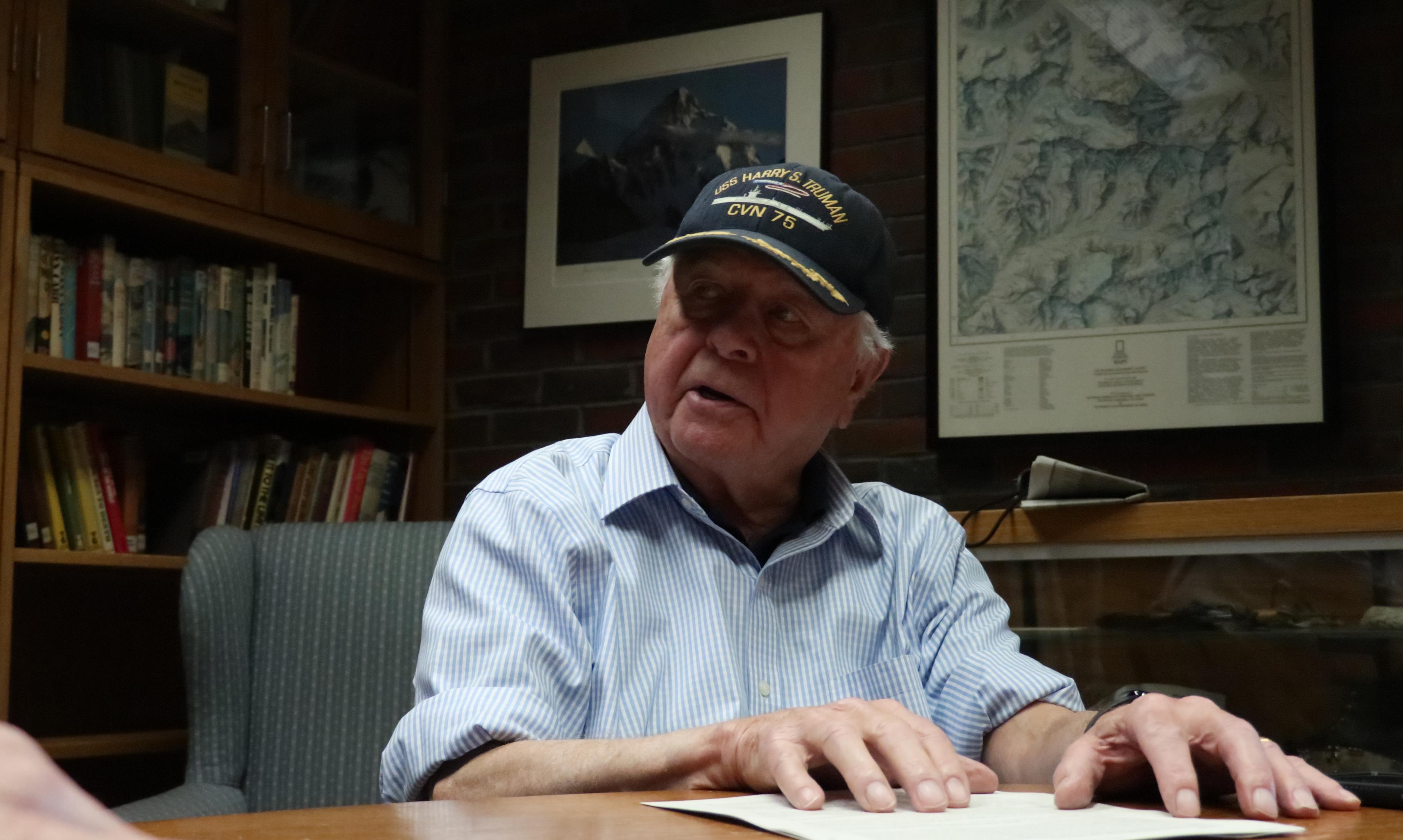
"I’ve always been a believer in service,” Bob DeVore ’58 says. A veteran of the Air National Guard, he doesn’t just mean in the military. In advance of Veterans Day, DeVore joined Emeritus Instructor of History Jack Herney ’46; ’69, ’71, ’74, ’92, ’95 (Hon.) at the Class of 1945 Library to talk about the way his experiences early in life, during Vietnam, and throughout his business career ingrained a sense of devotion to others.
Growing up in Indian River, a small northern Michigan community, DeVore watched his parents work long hours at the family’s modest inn during summers, when vacationers flocked to the area’s lakes. Seven days a week, the couple opened the restaurant at 7 a.m. and often closed at 1 a.m.
“My mother taught me a very, very important lesson, and it served me really well in my businesses,” DeVore recalled, referring to a career that has included leadership roles in health care management consulting and insurance, among other industries. “She said, ‘There’s two components of good service. One is production, and the other is hospitality.’”
DeVore attended a four-room schoolhouse and helped at the inn however he could. His path to Exeter began when a customer, whose children attended the Academy, met DeVore at a sailing summer camp and suggested he apply.
At the Academy, DeVore found non sibi embedded in the institution’s philosophy and its people — among them his ski coach, Bob Bates. A renowned mountaineer and longtime English instructor, Bates was also, as Herney pointed out during a discussion with DeVore in the library’s Bates Room, a veteran of the U.S. Army. But Bates never shared much about those years with DeVore.
“If you’ve never been shot at, it’s a very different feeling. You have no idea how you’re going to react.”
—Bob DeVore ’58
“That is consistent with most World War II guys,” DeVore said. “They just don’t talk about it.” Back then, he added, “We didn’t really have the respect for the mental side of what happens. And if you’ve never been shot at, it’s a very different feeling. You have no idea how you’re going to react until it happens.”
DeVore learned firsthand. After earning bachelor’s and master’s degrees in architecture from Harvard University, he received a traveling fellowship and studied Buddhist temples in Asia in 1965. To supplement his stipend, he worked as a deckhand in Saigon on an ammunition barge. The Vietnam War was well underway by then. He recalled one time anchoring in the Saigon River off a picturesque village and thinking he had seen fireworks illuminating its sand beach, palm trees and homes with thatched roofs. A sergeant informed him otherwise. “He grabs the back of my neck and throws me down on the deck,” DeVore recalled. “He said, ‘That’s automatic weapon fire.’”
When he returned to the States, DeVore enlisted in the Massachusetts Air National Guard. His time in Vietnam reinforced that he wanted to fly. “If I’m going to go to war, I’m going to be in an airplane. I’m not going to be in a foxhole,” he said. He was assigned to a construction squad as an engineering officer in the 101st Tactical Fighter Group. DeVore recounted a time he boldly told a colonel that their squadron wasn’t making the most of its talent. They had “Ph.D.s from MIT and Harvard cutting grass,” he said.
Instead of rebuking DeVore, the colonel asked him for suggestions. With help from some of those Ph.D.s, DeVore developed a computer model that matched airmen with tasks better suited to their backgrounds and skills. When the Guard switched from F-84s used in the Korean War to more modern F-100s for Vietnam, DeVore used his model to lead an aircraft transition program. It worked so well that it became the standard across the Air Force. DeVore was honorably discharged as a first lieutenant in 1972. He believes the U.S. would benefit from mandating two years of public service after high school — in whatever form, as his mother might say, a young person can be most productive.